DEFINE
State one exact research question.
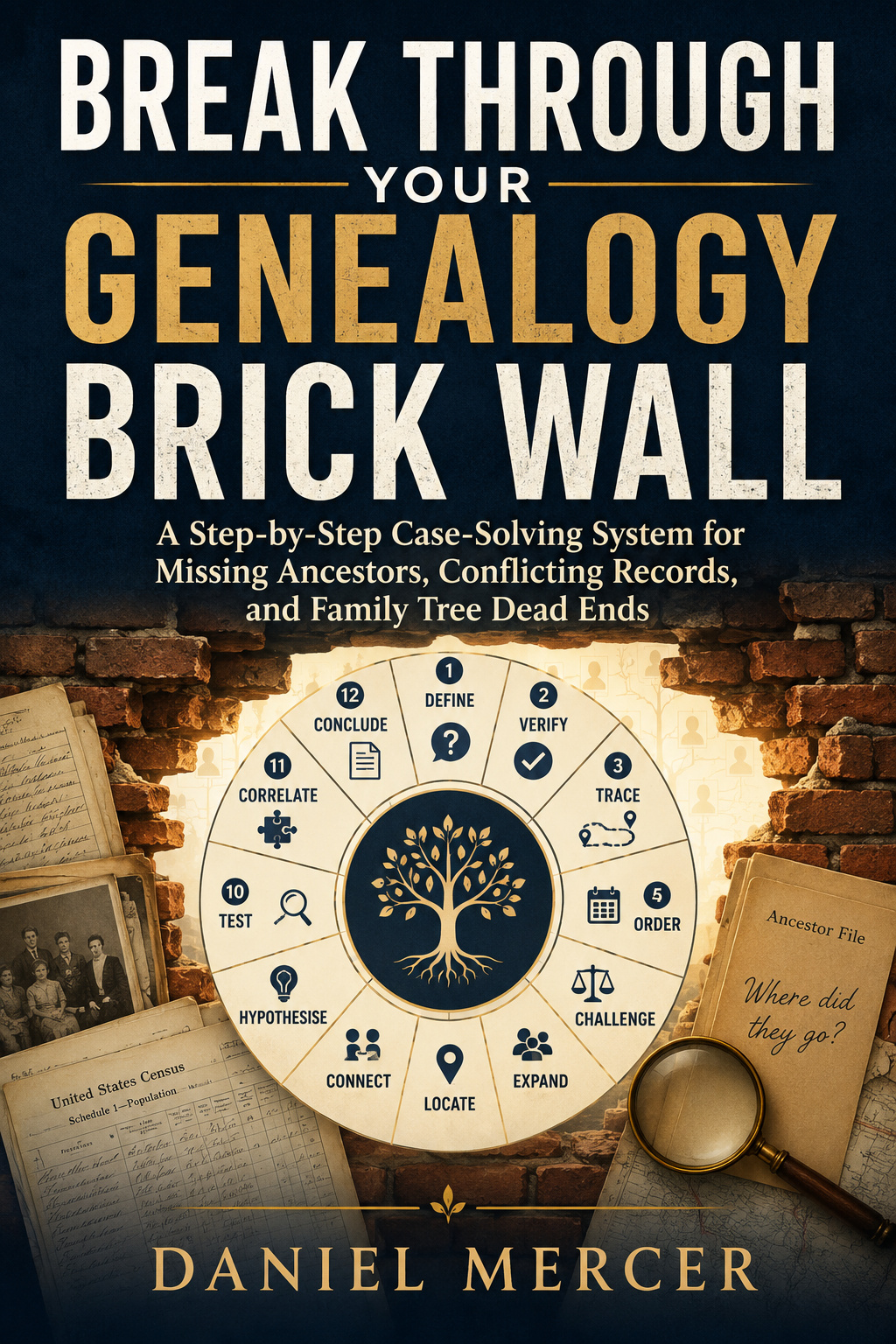
GENEALOGY RESEARCH
A Step-by-Step Case-Solving System for Missing Ancestors, Conflicting Records, and Family Tree Dead Ends
By Daniel Mercer · Published by Mercer Lane Press
A practical case-solving system for difficult family-history research that turns repeated searching into a structured investigation: define one question, verify the evidence, trace provenance, build a timeline, preserve contradictions, expand names and jurisdictions, research associates, test competing hypotheses, correlate the evidence, and record a defensible conclusion.
WHO IT IS FOR
Family historians who already have a tree, records, or inherited claims but are stuck on a missing ancestor, uncertain parentage, conflicting dates or places, same-name identities, migration gaps, or a record that seems to have disappeared.
THE BRICK WALL CASE CYCLE
The method keeps the same labels from the first diagnostic through the final conclusion so that every search has a reason and every conclusion can be traced back to evidence.
State one exact research question.
Separate supported facts from assumptions and inherited claims.
Identify where each important statement came from and who supplied it.
Build a chronological timeline and expose gaps or impossible sequences.
Preserve contradictions instead of choosing the version you prefer.
Treat names, ages, birthplaces, and identities as variables.
Reconstruct the historical jurisdiction and record-creation system.
Research relatives, neighbours, witnesses, and other useful associates.
Create more than one plausible explanation.
Choose evidence that can distinguish, support, or weaken those explanations.
Evaluate the evidence together rather than counting records.
Record the case as SOLVED, WORKING CONCLUSION, or OPEN CASE.
CASE FILE TOOLS
Use a Brick Wall Question Sheet, Known-Facts Ledger, Provenance Audit, and Evidence Timeline to separate what the evidence actually supports from what the tree merely displays.
Use a Contradiction Matrix, Name Variant Matrix, and Locality Reconstruction Sheet to preserve disagreements, test identity, and locate the record-creation system that applied at the time.
Use an Associate Network Map and family reconstruction to investigate siblings, children, neighbours, witnesses, sponsors, migration companions, and other people who may preserve indirect evidence.
Build competing hypotheses, rank useful next searches, write the predicted evidence before searching, and keep negative results precise enough to matter later.
Evaluate evidence streams together, resolve conflicts where the surviving evidence allows it, and test whether a competing explanation fits just as well.
Close the current round as SOLVED, WORKING CONCLUSION, or OPEN CASE, including the remaining uncertainty and the next evidence that could change the decision.
FIVE WORKED PLAYBOOKS
Narrow the disappearance window, test migration and identity, then change record type instead of repeating the same census search.
Use recurring associates and family connections to move from a broad country label toward a locality that can be tested without forcing a conclusion.
Build a surname chronology and ask whether apparently conflicting names describe different stages of the same life.
Separate identity clusters and timelines, then test whether the records can physically belong to one person.
Decompose one large mystery into identity, date, name, place, and relationship questions that can be investigated separately.
FREE SUPPORTING GUIDES
GENEALOGY
A practical reset for genealogy cases that have grown too broad, too assumption-heavy, or too dependent on repeated searches.
Read the guideGENEALOGY
A step-by-step way to order evidence chronologically without forcing dates, places, or identities to be cleaner than the sources justify.
Read the guideGENEALOGY
A practical contradiction-matrix method for genealogy cases where several records cannot all be accepted at face value.
Read the guideGENEALOGY
A disciplined alternative to guessing dozens of spellings when a historical person disappears from an index.
Read the guideGENEALOGY
A locality-first method for cases where a birth, marriage, naturalization, probate, census, or other expected record cannot be found.
Read the guideGENEALOGY
A focused way to search sideways when the target ancestor's own records no longer answer the question.
Read the guideRESEARCH LIMITS
Historical evidence can be incomplete, inaccurate, contradictory, destroyed, never created, or held somewhere unexpected. The book is educational family-history guidance, not legal, citizenship, immigration, tax, medical, or other regulated advice. Research involving living people, private correspondence, parentage, adoption, or DNA requires particular care with privacy, consent, and the rules of the services and jurisdictions involved.
SEARCH BY THE PROBLEM
Family historians searching for genealogy brick-wall help are usually facing a missing ancestor, conflicting dates or places, a same-name identity or a record that cannot be found. The guide turns repeated searching into a case-solving process.