SCOPE
Define what you believe you are pricing and make open questions visible.
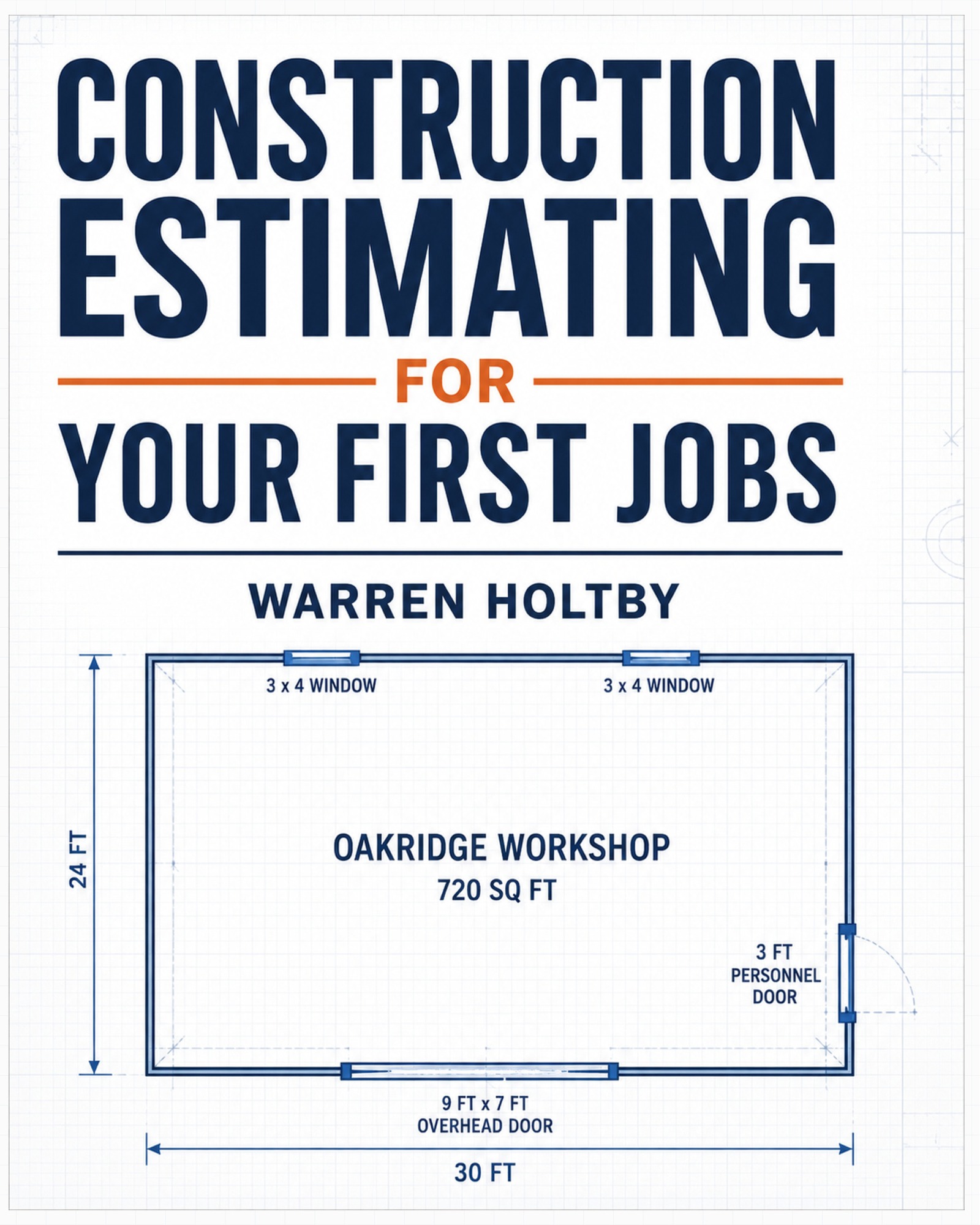
CONSTRUCTION ESTIMATING
A Beginner's Worked-Example Guide to Quantity Takeoffs, Labor, Waste, Overhead, Markup, Bid Review, and Avoiding Costly Estimating Mistakes
By Warren Holtby · Published by Mercer Lane Press
A beginner-focused worked-example guide to construction estimating that follows one fictional workshop from scope and quantity takeoff through material purchasing, labor hours, subcontract quotes, overhead and margin, bid review, proposal, and post-job learning.
WHO IT IS FOR
Contractors and estimators pricing their first jobs who understand how construction work goes together but want a repeatable process for making scope, quantities, assumptions, labor, quotations, cost recovery, and final bid review visible and traceable.
THE ESTIMATING SEQUENCE
The book keeps the same process visible from the first scope question to the post-job review so that the final number can be traced back to the information and assumptions that created it.
Define what you believe you are pricing and make open questions visible.
Build the estimate shell before detailed costs are entered.
Develop quantities that retain their units, calculations, and source documents.
Turn quantities and work into material, labor, subcontract, and project-specific cost.
Apply the company's deliberate overhead and commercial treatment without double counting.
Look deliberately for omissions, stale inputs, wrong assumptions, and document mismatches.
Translate the internal estimate into a customer-facing offer with a defined scope.
Compare estimate and actual performance where possible and update the system for a justified reason.
ONE FICTIONAL PROJECT, END TO END
A fictional 24 ft × 30 ft workshop provides a consistent training project for scope mapping, control quantities, marked-up takeoff, work packages, and question logs.
The worked example keeps measured quantities separate from purchasing quantities, builds labor from activities and person-hours, and makes supplier and subcontract sources visible.
The first calculated estimate is deliberately incomplete. A structured review catches omitted trim work and an expired quotation before the commercial calculation is rebuilt, then the example continues into proposal and post-job comparison.
WHAT THE BOOK BUILDS
Included, excluded, clarify, and by-others buckets; question logs; work-package structure; source fields; revision control; and clear unresolved statuses.
Control quantities, gross and net takeoff, units, calculations, stock lengths, sheets, packs, layout effects, and a visible reason for the difference between measured and purchased quantity.
Activity → crew → time → person-hours → labor cost, plus horizontal subcontract scope comparison, interfaces, validity, exclusions, allowances, and gap checks.
Materials, labor, subcontract, and job-specific costs remain distinct from company overhead; markup and margin are treated as different calculations with different denominators.
Scope, quantities, labor, quotations, commercial math, documents, and sanity are challenged before the estimate becomes a customer-facing offer.
Estimate and actual records are compared by useful work packages, with variances classified before the estimating system is changed.
FREE SUPPORTING GUIDES
CONSTRUCTION ESTIMATING
Measurement answers how much, but it cannot decide what is actually included. Define responsibility and unresolved questions before detailed takeoff so an unknown does not quietly become a zero-cost assumption.
Read the guideCONSTRUCTION ESTIMATING
A takeoff quantity is not automatically an order quantity. Preserve the geometry first, then convert it into whole pieces, sheets, rolls, packs, or other purchasing units with a visible reason for every adjustment.
Read the guideCONSTRUCTION ESTIMATING
When clean production history is limited, write the operating story behind the labor allowance. Use the best evidence available, translate crew and duration into person-hours, sanity-check the result, and compare it with actual performance later.
Read the guideCONSTRUCTION ESTIMATING
A subcontractor gives you a number, but the number is useful only when you know what it represents. Compare important scope points horizontally so a lower total is not mistaken for a more complete quotation.
Read the guideCONSTRUCTION ESTIMATING
Markup compares an addition with cost; margin compares profit with selling price. The arithmetic is universal, but a real contractor's overhead method and target percentages must come from the company's own financial information.
Read the guideCONSTRUCTION ESTIMATING
A spreadsheet can calculate exactly what it was told to calculate while still missing work or carrying stale inputs. Freeze a review copy, then attack the estimate from the bottom of the cost chain upward.
Read the guideCONSTRUCTION ESTIMATING
A useful construction estimating spreadsheet should do more than total line items. It should make scope, quantities, labour, quotations, commercial assumptions, review checks and post-job learning visible enough to challenge before the bid goes out.
Read the guideCONSTRUCTION ESTIMATING
A simple construction estimate template can be enough for small, familiar work. A fuller estimating system becomes more useful when scope, takeoff, labour, quotations, review and client output need to stay connected and auditable.
Read the guideCONSTRUCTION ESTIMATING
Estimate-vs-actual job costing turns a completed job into estimating feedback. Compare the original cost assumptions with actual materials, labour, subcontract and job-specific costs, then record why the variance occurred.
Read the guideCONSTRUCTION ESTIMATING
A contractor bid spreadsheet should keep the internal estimate and the client proposal connected but separate. Review the estimate first, then carry the approved price and customer-facing scope into a clean proposal.
Read the guideSCOPE & SAFETY
The book provides educational information about construction estimating processes. It does not provide engineering, architectural, legal, tax, accounting, insurance, electrical, gas, code-compliance, or other licensed professional advice. Real estimates should use current project-specific documents and suitable information from suppliers, subcontractors, company records, regulatory sources, and qualified professionals.
SEARCH BY THE PROBLEM
Beginner estimators commonly search how to estimate a construction job, do a quantity takeoff, price labor, allow for waste and understand markup versus margin. The book follows one worked job from scope through submission and post-job learning.