Observe precisely
Record what was supposed to happen, what happened instead, the exact error, the failed image or log, and the first abnormal event you can identify.
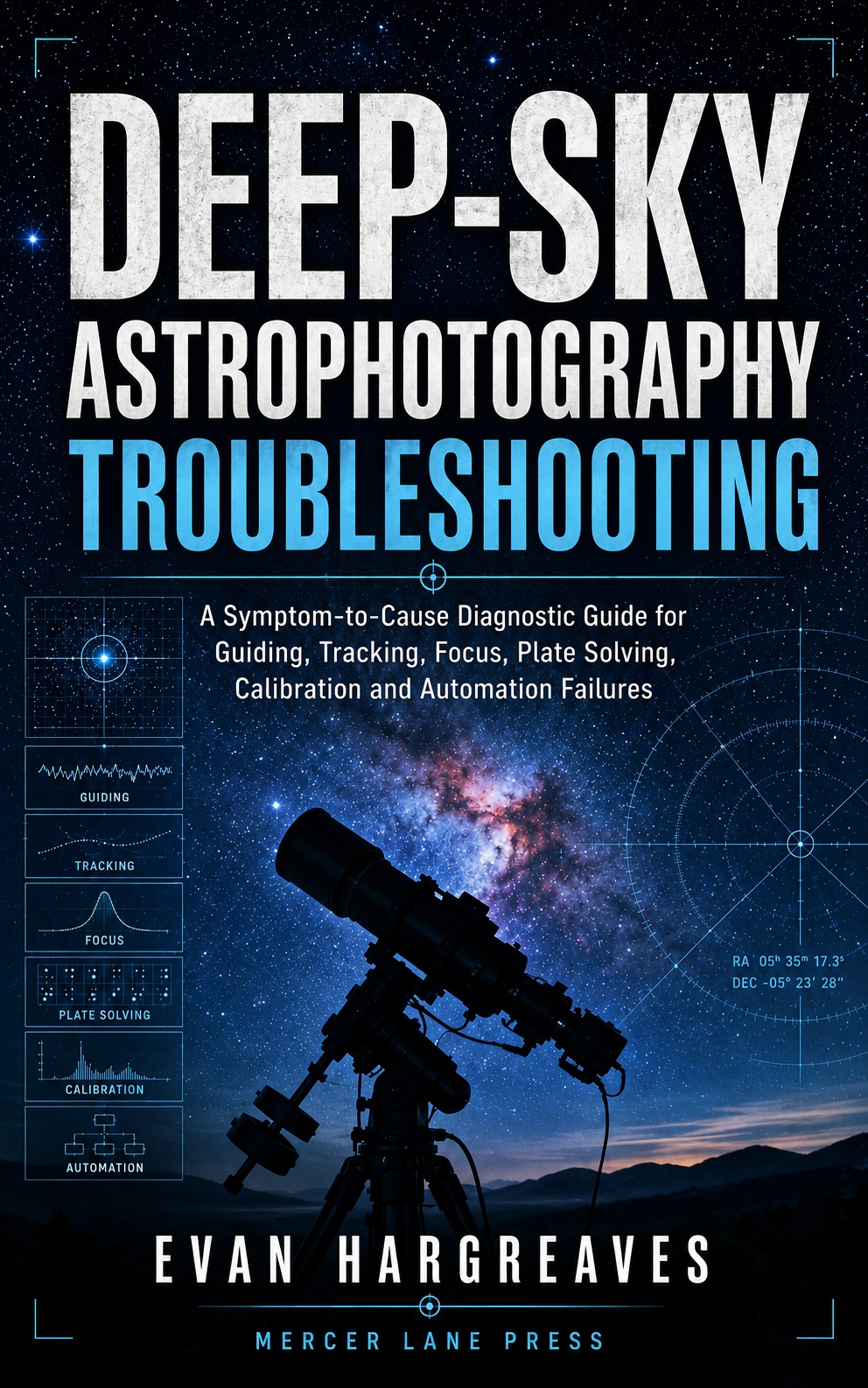
DEEP-SKY ASTROPHOTOGRAPHY
A Symptom-to-Cause Diagnostic Guide for Guiding, Tracking, Focus, Plate Solving, Calibration and Automation Failures
By Evan Hargreaves · Published by Mercer Lane Press
A symptom-to-cause diagnostic manual for deep-sky imagers who need to separate guiding, tracking, focus, plate-solving, calibration, communication, optical, and automation failures using controlled tests instead of speculative setting changes.
WHO IT IS FOR
Astrophotographers who already understand the basic language of deep-sky imaging and want a structured way to make a complete imaging rig work reliably when several different faults can produce the same symptom.
THE DIAGNOSTIC METHOD
A visible failure is the starting point, not an explanation. The method is designed to reduce uncertainty before settings, hardware, or workflow are changed.
Record what was supposed to happen, what happened instead, the exact error, the failed image or log, and the first abnormal event you can identify.
Use a test that separates failure families: manual guide motion, a short-versus-long exposure comparison, a blind solve, a direct connection, or a supervised automation step.
Prefer a cause that explains the evidence and predicts when the behavior should recur rather than a vague label such as “guiding” or “USB.”
Correct the identified physical, power, communication, configuration, optical, or automation mechanism without changing unrelated parameters at the same time.
Repeat the representative operation and inspect the result. A successful software status or brief improvement is not enough on its own.
Keep a baseline for the actual rig configuration so future failures can be compared with something already shown to work.
SYSTEM-WIDE COVERAGE
Trailing stars, calibration failures, changing guide performance, RA and DEC behavior, spikes, oscillation, lost stars, dithering, flexure, wind, and cable drag.
Plate solving, wrong target position, slew-and-center chains, meridian flips, overnight sequence stops, and the difference between the final abort and the first abnormal event.
Reaching focus, failed autofocus, focus drift, asymmetric or corner star shapes, spacing, tilt, dew, frost, reflections, and unexpected light.
Flats that over-correct, dark mismatch, camera-specific bias or dark-flat choices, dust donuts, vignetting, and finding the first calibration stage that introduces an artifact.
Devices that never connect or disconnect later, shared hubs and power dependencies, load-related faults, cable paths, and minimal direct-connection tests.
The Ten-Minute Night Rescue separates a simple recoverable fault from a safe workaround or a reason to stop and preserve the evidence for later diagnosis.
FREE SUPPORTING GUIDES
ASTROPHOTOGRAPHY
Do not assume elongated stars are a guiding problem. First decide whether the pattern is movement at all, then use exposure length, frame position, guide data, axis direction, and event timing to isolate the likely failure family.
Read the guideASTROPHOTOGRAPHY
A plate solver can fail because the image is not sufficiently solvable or because the solver is working from bad assumptions. Inspect the actual exposure first, then use a blind solve and configuration checks to separate those two families.
Read the guideASTROPHOTOGRAPHY
Autofocus is a chain of camera exposures, star measurements, focuser movements, curve fitting, return motion, and verification. Find the first stage that fails instead of assuming the focuser or algorithm is broken.
Read the guideASTROPHOTOGRAPHY
An automated meridian flip is a chain of state transitions, not one command. Test it under supervision, identify the last successful stage, and diagnose the first broken transition instead of changing the whole sequence.
Read the guideASTROPHOTOGRAPHY
A flat is a measurement of a particular optical configuration, not a generic image-improvement frame. Identify the first calibration stage that introduces the artifact, then verify geometry, illumination, exposure, and zero-level treatment.
Read the guideSOFTWARE & EQUIPMENT SCOPE
The book discusses common astrophotography software and control frameworks as examples, but the method is not tied to one application. Drivers, firmware, menus, defaults, and device capabilities change, so current official documentation remains the reference when a specific interface behaves differently.
SEARCH BY THE PROBLEM
Deep-sky imagers often search after seeing star trails, bad guiding, failed plate solving, autofocus problems or broken meridian flips. Because several faults can create similar symptoms, this guide focuses on tests that separate causes before settings are changed.