Rules & operating procedures
FCC responsibilities, privileges, licensing, identification, control operators, repeaters, simplex, nets, emergency communication, ARES, RACES, and traffic.
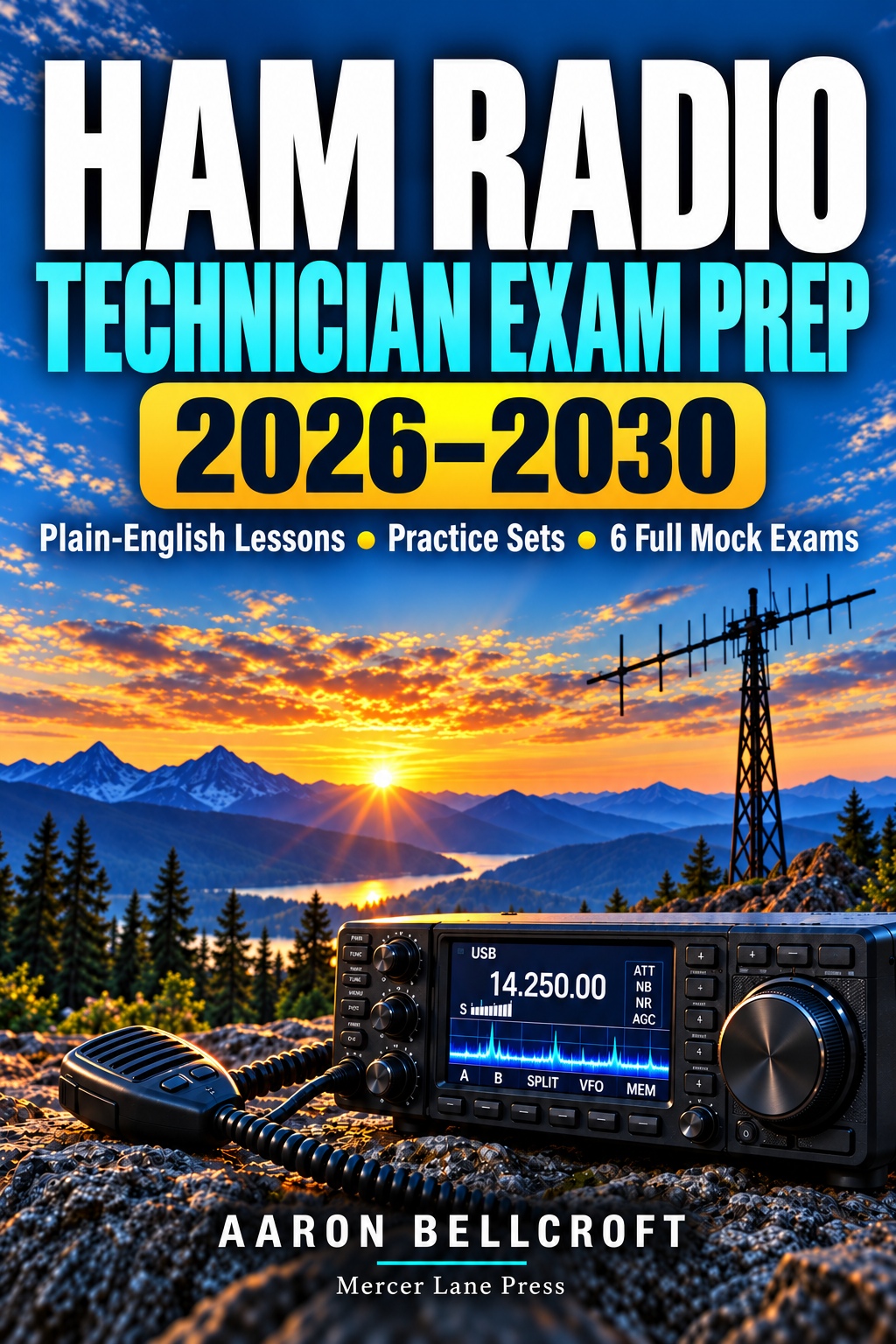
HAM RADIO TECHNICIAN EXAM · 2026–2030
Plain-English Lessons • Exam Traps • Practice Sets • Six Full 35-Question Mock Exams
By Aaron Bellcroft · Published by Mercer Lane Press
A concept-focused study guide for the 2026–2030 Technician Class exam, organized around all 35 official exam groups with plain-English lessons, exam traps, six-question drills, six full 35-question mock exams, and quick-reference review tools.
WHO IT IS FOR
Candidates preparing for the 2026–2030 Technician Class Element 2 exam who want a structured way to understand the concepts behind all 35 official groups, practise recall, identify weak group codes, and use mixed mock exams rather than relying only on memorized answer patterns.
THE 35-GROUP SYSTEM
A Technician exam contains 35 questions, with one question drawn from each of the 35 official groups. The book uses that blueprint as its organizing system instead of treating the 409-question pool as one undifferentiated list.
FCC responsibilities, privileges, licensing, identification, control operators, repeaters, simplex, nets, emergency communication, ARES, RACES, and traffic.
Line of sight, multipath, wavelength, radio horizon, special propagation, antenna types, resonance, feed lines, connectors, tuners, and SWR.
Voltage, current, resistance, power, metric conversions, decibels, capacitance, inductance, impedance, Ohm's Law, series, and parallel.
Passive components, switches, batteries, diodes, transistors, official schematic figures, rectifiers, relays, regulators, transformers, and tuned circuits.
Transceiver blocks, troubleshooting, instruments, soldering, modulation, bandwidth, satellites, Doppler shift, direction finding, linking, and digital modes.
Electrical and battery safety, antenna and tower hazards, power-line safety, RF exposure, and the point where study material does not replace current rules, codes, or appropriate professional training.
HOW THE STUDY LOOP WORKS
Each group starts with a big-picture explanation, works through high-yield concepts, isolates common exam traps, and finishes with a six-question drill. Misses are marked by group code so mixed mock exams point back to a precise weakness.
Each mock contains 35 questions, with one question from each official group, so practice follows the same blueprint rather than concentrating only on familiar topics.
The real exam pass mark is 26/35. The book recommends reaching at least three consecutive mixed mock scores of 30/35 with no recurring rules or safety weakness. That is a study recommendation, not an FCC requirement or a guarantee.
The back matter includes a formula sheet, Technician privilege landmarks, a first-seven-days checklist, rapid glossary, final 35-group cram map, score tracker, and exam-day checklist.
FREE SUPPORTING GUIDES
The free guides below cover the exam blueprint, a two-week study schedule, formula and unit work, privilege landmarks, and a simple first week after passing.
HAM RADIO TECHNICIAN EXAM
The Technician exam is built from 35 official groups, with one question drawn from each group. Study by group, record misses by group code, and use mixed practice to find recurring weak areas.
Read the guideHAM RADIO TECHNICIAN EXAM
Spread the 35 exam groups across twelve learning days, then use the final two days for mixed mock exams and targeted correction rather than last-minute random cramming.
Read the guideHAM RADIO TECHNICIAN EXAM
Keep the small amount of Technician math predictable: identify the quantity and unit first, select the relationship, substitute values with units, and check whether the answer is physically sensible.
Read the guideHAM RADIO TECHNICIAN EXAM
Use a small set of frequency and power landmarks to organize Technician privilege questions, while checking current FCC privileges before operating rather than treating a study sheet as legal authority.
Read the guideHAM RADIO TECHNICIAN EXAM
Passing the exam is the beginning of operating practice. Use the first week to verify the FCC grant, make one simple local contact, test simplex and your antenna system, listen to a net, and choose one next skill.
Read the guidePOOL & INDEPENDENCE NOTE
The edition identifies its pool control as the February 19, 2026 revision, effective July 1, 2026 through June 30, 2030. It is concept-focused rather than a line-by-line reproduction of all 409 official question stems.
The book is independent study material and is not endorsed by, affiliated with, or sponsored by the FCC, NCVEC, ARRL, or any Volunteer Examiner Coordinator.
SEARCH BY THE PROBLEM
Current exam searches strongly centre on Ham Radio Technician practice tests, the 2026–2030 question pool and full 35-question mock exams. This guide combines concept teaching with practice rather than using outdated 2022–2026 material.