CAPTURE
Make every legitimate maintenance demand visible in one controlled work system.
MAINTENANCE WORK MANAGEMENT
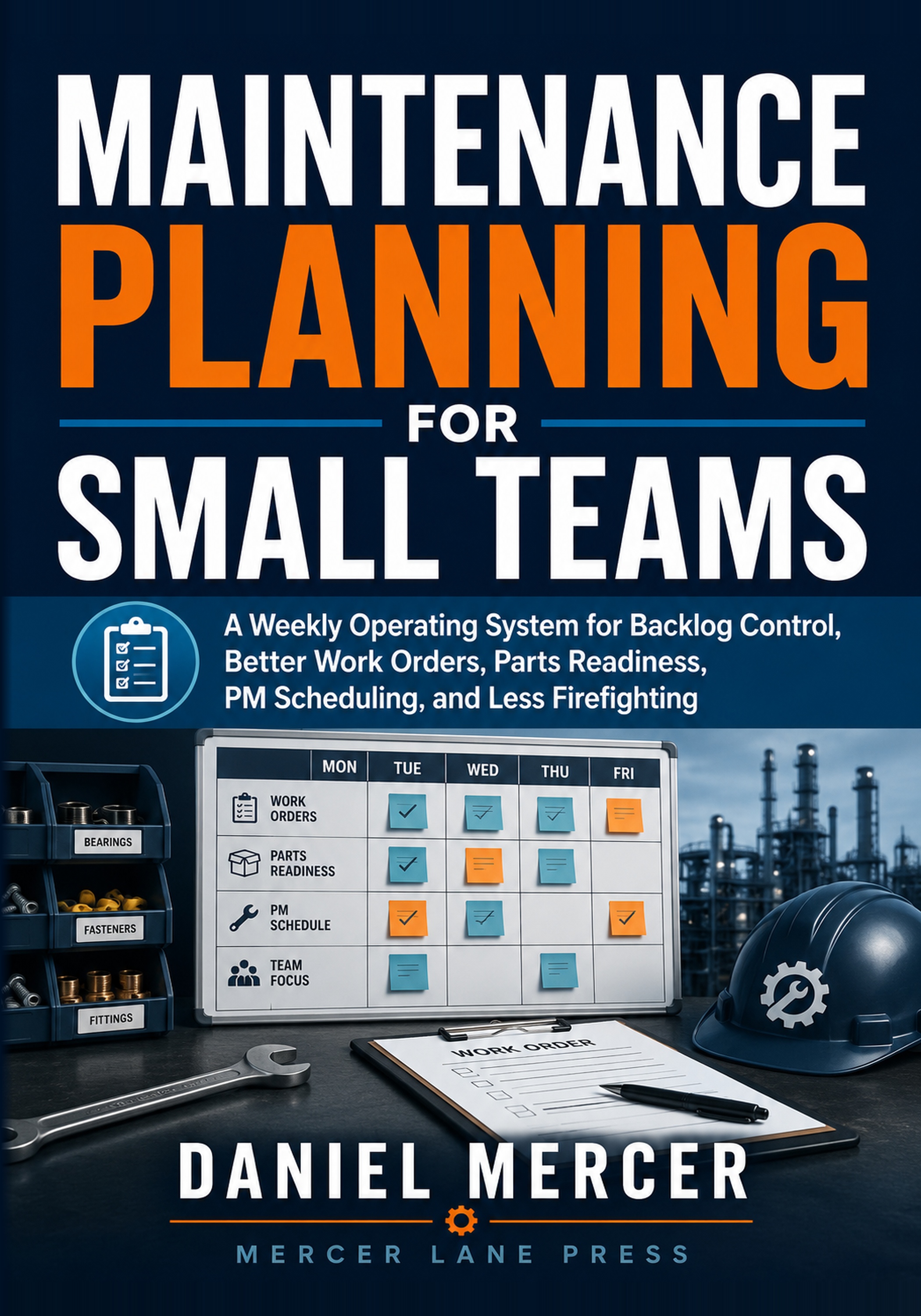
A Weekly Operating System for Backlog Control, Better Work Orders, Parts Readiness, PM Scheduling, and Less Firefighting
By Daniel Mercer · Published by Mercer Lane Press
A practical small-team maintenance planning system that separates work capture, triage, planning, readiness, weekly commitment, execution, closeout, and review so supervisors can control backlog, prepare executable work, coordinate parts and production access, schedule against realistic labor capacity, and learn from schedule changes without building a large-company bureaucracy.
WHO IT IS FOR
Maintenance supervisors, planners, managers, lead technicians, and small industrial maintenance teams where one person may cover several planning, scheduling, coordination, stores, and supervisory responsibilities.
THE OPERATING LOOP
The book uses a repeating operating loop from work capture through review. The purpose is not more administration. It is to stop importance, readiness, scheduling, execution, and closeout from being treated as if they were the same decision.
Make every legitimate maintenance demand visible in one controlled work system.
Decide consequence and urgency before pressure becomes priority.
Define the scope, labor, material, access, support, and information the job will need.
Confirm enough uncertainty has been removed to make assignment reasonable.
Select work that fits real people, skills, PM demand, access, and weekly capacity.
Protect the agreed plan while making genuine break-ins and displacement visible.
Record what happened, what changed, and what the next person should know.
Use schedule loss, waiting reasons, actual labor, and feedback to improve the next cycle.
THE READY GATE
A high-priority work order can still be impossible to execute. The Ready Gate gives the team a compact way to distinguish important work from work that is prepared well enough to commit.
Is the asset correct, the intended work clear enough, and the finish condition understandable?
Are the required skills, number of people, competence needs, and usable labor estimate understood?
Are important parts and consumables identified, physically available or otherwise controlled, and reserved where the job needs that protection?
Is the equipment-release window credible, is production preparation known, and can the crew physically reach the work?
Are special tools, drawings, other trades, contractors, access equipment, lifting, or technical support arranged where required?
Have relevant site isolation, permit, authorization, specialist-control, and return-to-service dependencies been identified without inventing technical procedures?
BUILD THE WEEK FROM CAPACITY
Gross paid hours are reduced by known leave, training, meetings, standing duties, skill constraints, and other real commitments before planned work is loaded.
Use recent local evidence to reserve capacity for normal uncertainty instead of filling every available hour and hoping nothing breaks.
Preventive maintenance, contractor visits, shutdown work, and agreed production windows consume the same people and access as corrective work.
Choose executable work by consequence, access, skill, labor, and opportunity rather than by age, requester pressure, or work-order count alone.
If a job finishes early or reactive demand is lower than expected, pull from an already prepared candidate list instead of improvising from the whole backlog.
When the week changes, make the reason visible: emergency, access, parts, staffing, overrun, readiness, contractor support, or management reprioritization.
PRACTICAL TOOL PACK
The book closes with a 14-part tool pack designed to support the operating rhythm without creating a second maintenance system.
Work-Request Standard, Priority Decision Matrix, Backlog-State Reference, and Ready / Not-Ready Gate.
Planning-Depth Decision Tool, Standard Job-Plan Template, and Parts-Readiness Check.
Weekly Capacity Calculator, Weekly Scheduling Board, and Schedule Change / Displacement Record.
Work-Order Closeout Standard, Schedule-Loss Reason Codes, Weekly Maintenance Review, and 30-Day Implementation Checklist.
FREE SUPPORTING GUIDES
MAINTENANCE PLANNING
Improve the front end of the maintenance backlog by asking for observable facts, consequence, timing, and a useful contact instead of vague requests such as “check pump” or “urgent.”
Read the guideMAINTENANCE PLANNING
A job can be important and still be impossible to execute. Use six readiness checks - scope, people, material, access, support, and control - before technician time is committed.
Read the guideMAINTENANCE PLANNING
Gross paid hours are not schedulable hours. Calculate the labor the team can honestly commit, retain capacity for normal uncertainty, then load PM and ready corrective work against the skills and access actually available.
Read the guideMAINTENANCE PLANNING
A job can be fully planned, have the right part, and still fail when production cannot release the asset. Move access conversations earlier and make deferral a visible business decision.
Read the guideMAINTENANCE PLANNING
Do not try to rebuild the entire maintenance system at once. Use four weeks to establish one work system, meaningful states and priority, a Ready Gate, realistic weekly capacity, and a review loop.
Read the guideSAFETY AND PROFESSIONAL SCOPE
The book helps teams identify planning dependencies such as equipment access, permits, isolation requirements, specialist competence, contractor support, and return-to-service needs. It does not replace site procedures, risk assessment, manufacturer instructions, competent technical judgment, approved safety systems, engineering design, or applicable legal and regulatory requirements.
SEARCH BY THE PROBLEM
Maintenance teams commonly search for backlog control, better work orders, preventive-maintenance scheduling, ready work and weekly maintenance schedules. The guide connects those tasks into a small-team operating rhythm.