Advantage
Use useful position, height, balance, time, or opponent vulnerability without giving the advantage away through impatience.
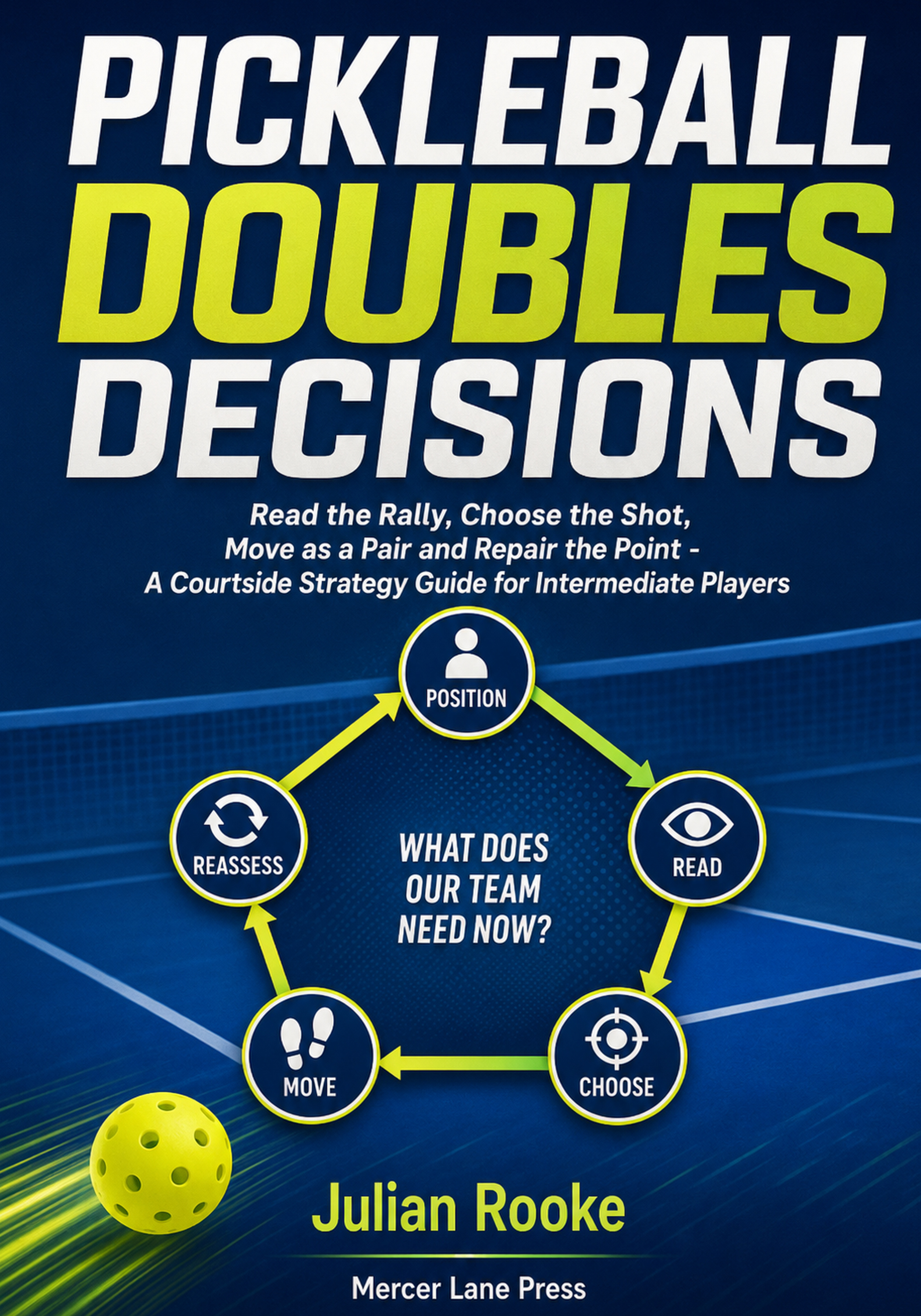
PICKLEBALL DOUBLES STRATEGY
Read the Rally, Choose the Shot, Move as a Pair and Repair the Point - A Courtside Strategy Guide for Intermediate Players
By Julian Rooke · Published by Mercer Lane Press
A practical doubles strategy guide for intermediate pickleball players who already know the basic shots and want a clearer system for reading rally state, choosing the next job, moving with a partner, and repairing points when the normal pattern breaks.
WHO IT IS FOR
Intermediate doubles players around the recreational 3.0-3.5 level who can sustain rallies and produce the basic shots but do not yet make consistently strong doubles decisions, including players who regularly change partners.
THE CORE DECISION SYSTEM
The book separates tactical decisions from stroke labels. A rally can be in Advantage, Neutral, or Pressure, and the job changes with the state.
Use useful position, height, balance, time, or opponent vulnerability without giving the advantage away through impatience.
Maintain an unattackable ball or create something: movement, discomfort, a gap, or a weaker next contact.
Survive, neutralize, and rebuild before trying to dominate the exchange again.
The Rally Decision Loop starts with all four players and the incoming ball, asks what job the team needs, then makes movement depend on what the shot actually earned. The opponents' next contact starts the loop again.
FROM OPENING BALL TO BROKEN PATTERN
Connect the serve, return, third shot, fourth ball, and fifth shot instead of treating the third-shot drop or drive as an isolated command.
Take the ground your ball earns, stop when the opponent's contact takes time away, reset when pressure demands it, and arrive balanced with your partner.
Dink to hold, move, jam, or create; test attackability before a speed-up; choose a target; and expect the counter rather than admiring the first attack.
Agree a default, let position override theory, call early, and recover after taking a ball that changes the team's shape.
Stay connected without blindly copying each other's feet. One player's shot and position change what the other player needs to cover next.
Recognize the break, reclassify the state, simplify the next job, stabilize, reconnect, and resume normal strategy only when the rally allows it.
FREE SUPPORTING GUIDES
These focused guides turn recurring doubles situations into a practical sequence you can review before or after play.
PICKLEBALL DOUBLES
The third shot is not a doctrine. Read the ball, the opponents, and your own reliability, then choose the option most likely to improve the serving team's position.
Read the guidePICKLEBALL DOUBLES
The transition zone is a decision zone, not a place to sprint through. Move while your ball gives time, stop when the opponent's contact takes time away, and reset when pressure needs to be neutralized.
Read the guidePICKLEBALL DOUBLES
A slightly high ball creates an opportunity, not an obligation. Test the whole situation before speeding up, choose a purpose and target, and assume the ball may come back.
Read the guidePICKLEBALL DOUBLES
Middle-ball problems are responsibility problems. Agree a default, let the player with the better contact override theory, call early, and recover after taking a ball that changes team shape.
Read the guidePICKLEBALL DOUBLES
Moving together does not mean copying your partner's feet. Preserve a defendable relationship, let shot quality control forward movement, and repair the formation when one player is pulled wide or left deep.
Read the guideCOURTSIDE REFERENCE
The final reference section is organized around court situations such as a high third-shot drop, one partner reaching the kitchen first, balls at the feet in transition, middle-ball conflicts, repeated pace, lobs, broken stacking, a targeted partner, and uncertainty about whether to attack, reset, or wait.
The objective is not to memorize a fixed script. It is to recognize the current state quickly enough to choose a useful next job for both partners.
SEARCH BY THE PROBLEM
Players searching for pickleball doubles strategy often want help with positioning, third-shot choices, transition-zone decisions, the middle and moving with a partner. This courtside guide connects those decisions to the state of the rally.