Input
Name the source of truth and remove information the task does not need.
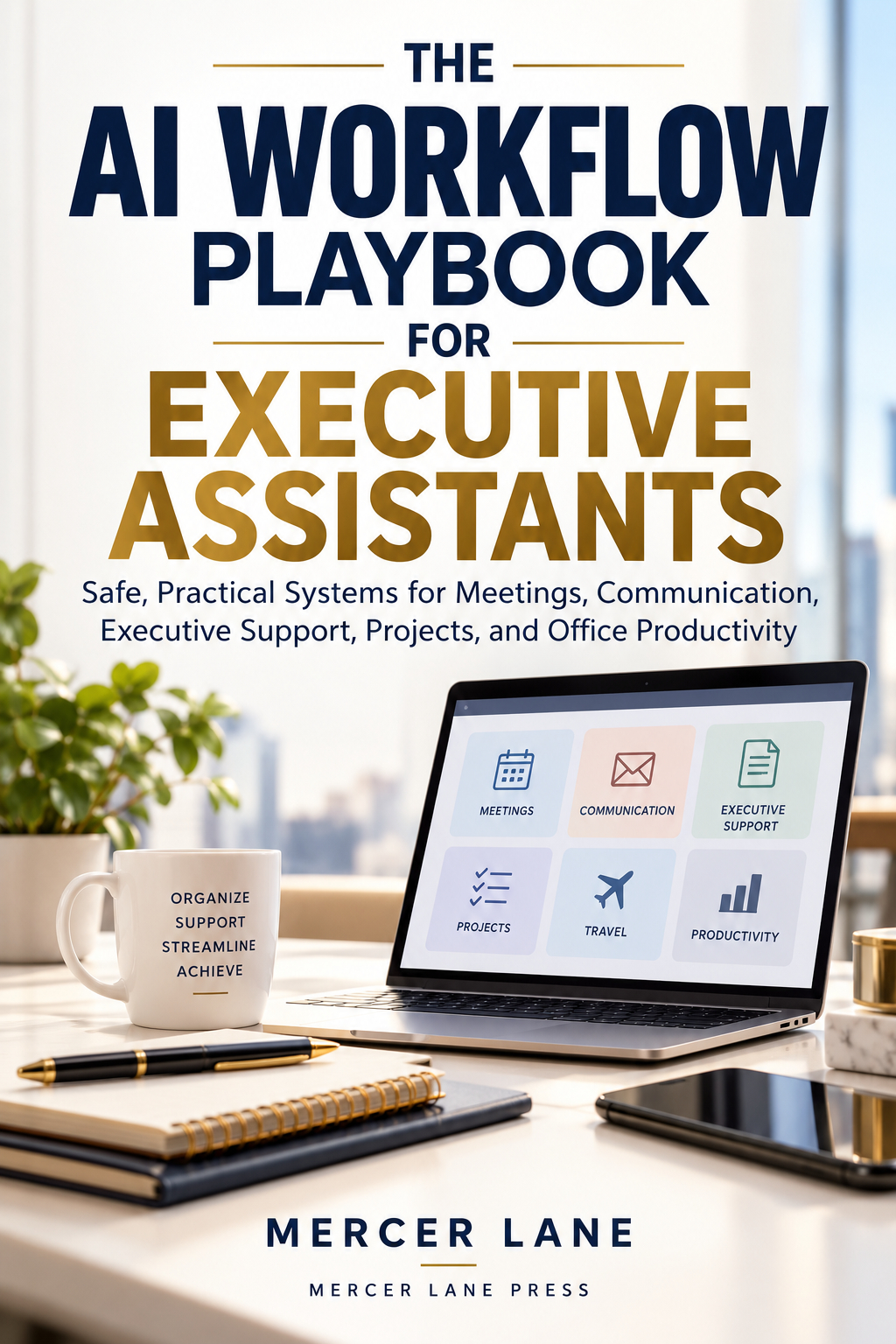
EXECUTIVE ASSISTANT AI
Safe, Practical Systems for Meetings, Communication, Executive Support, Projects, and Office Productivity
By Mercer Lane · Published by Mercer Lane Press
A practical, tool-neutral operating guide for executive assistants who want to use generative AI inside controlled workflows for meetings, communication, briefings, calendars, research, travel, projects, SOPs, documents, automation, and quality control while keeping source discipline, verification, judgment, and release authority with people.
WHO IT IS FOR
Executive assistants and other executive-support professionals who want a repeatable way to use AI for drafting, organizing, analysis, briefing, research, and workflow preparation without weakening confidentiality, source control, professional judgment, or the human authority behind commitments and release.
THE OPERATING MODEL
The book treats AI as one controlled stage inside the work. A fluent output is not the release point: the workflow names its factual authority, its likely failure, the person who owns the decision, and the condition that must be true before the result is used.
Name the source of truth and remove information the task does not need.
Define the bounded transformation, constraints, and output format.
Test the likely failure with a source, live system, checklist, or deterministic calculation.
Identify who has authority to resolve uncertainty, approve the result, or make the consequential choice.
Use the result only after the stated release condition has been met.
WHAT IT COVERS
Prepare decision-ready briefs, extract candidate decisions and actions, verify owners and dates, and build follow-up from a checked action register.
Draft in an approved voice while separately checking facts, commitments, disclosure, recipients, links, attachments, and release authority.
Build selective daily or weekly briefs, define source hierarchies, surface contradictions, and use AI to prepare scheduling options without inventing priority.
Separate discovery from evidence, verify current sources, time-stamp perishable information, compare constraints and trade-offs, and keep final decisions or bookings human-owned.
Turn vague requests into explicit project briefs, draft SOPs from real process evidence, and apply artifact-specific checks to documents, spreadsheets, and presentations.
Increase authority gradually, use least privilege and safe stop conditions, and scan for invention, omission, distortion, staleness, and authority creep.
IMPLEMENTATION
The book moves from a quick controlled first workflow into seventeen chapters, ten end-to-end implementation labs, fifteen failure patterns, eight reusable governance controls, a thirty-day operating system, a ninety-day maturity roadmap and executive–EA working agreement, reusable workflow cards, a larger workflow library, and release checklists.
FREE SUPPORTING GUIDES
Executive Assistant AI
Define the input, AI task, check, human decision, and release condition before you rely on a polished AI output.
Read the guideExecutive Assistant AI
Make the confidentiality decision before prompting: use organizational rules, provide only necessary details, and keep restricted information inside approved systems.
Read the guideExecutive Assistant AI
Treat meetings as a lifecycle: prepare from approved sources, extract candidate actions, verify decisions and ownership, then communicate from the checked register.
Read the guideExecutive Assistant AI
Use AI to prepare executive communication without allowing a polished draft to accept dates, promise resources, imply decisions, or reveal private context.
Read the guideExecutive Assistant AI
Increase AI authority one level at a time, prove the lower-authority workflow first, and design permissions, exceptions, logging, and rollback before automated action.
Read the guideSEARCH BY THE PROBLEM
If you are looking for AI prompts for executive assistants, meeting-summary workflows, executive email drafting, briefing support or safer ways to use AI in day-to-day executive support, this guide focuses on repeatable work rather than one-off prompt tricks.