Observe the change
Record what looks, sounds, feels, or tests differently, when the pool was last normal, and what happened between then and now.
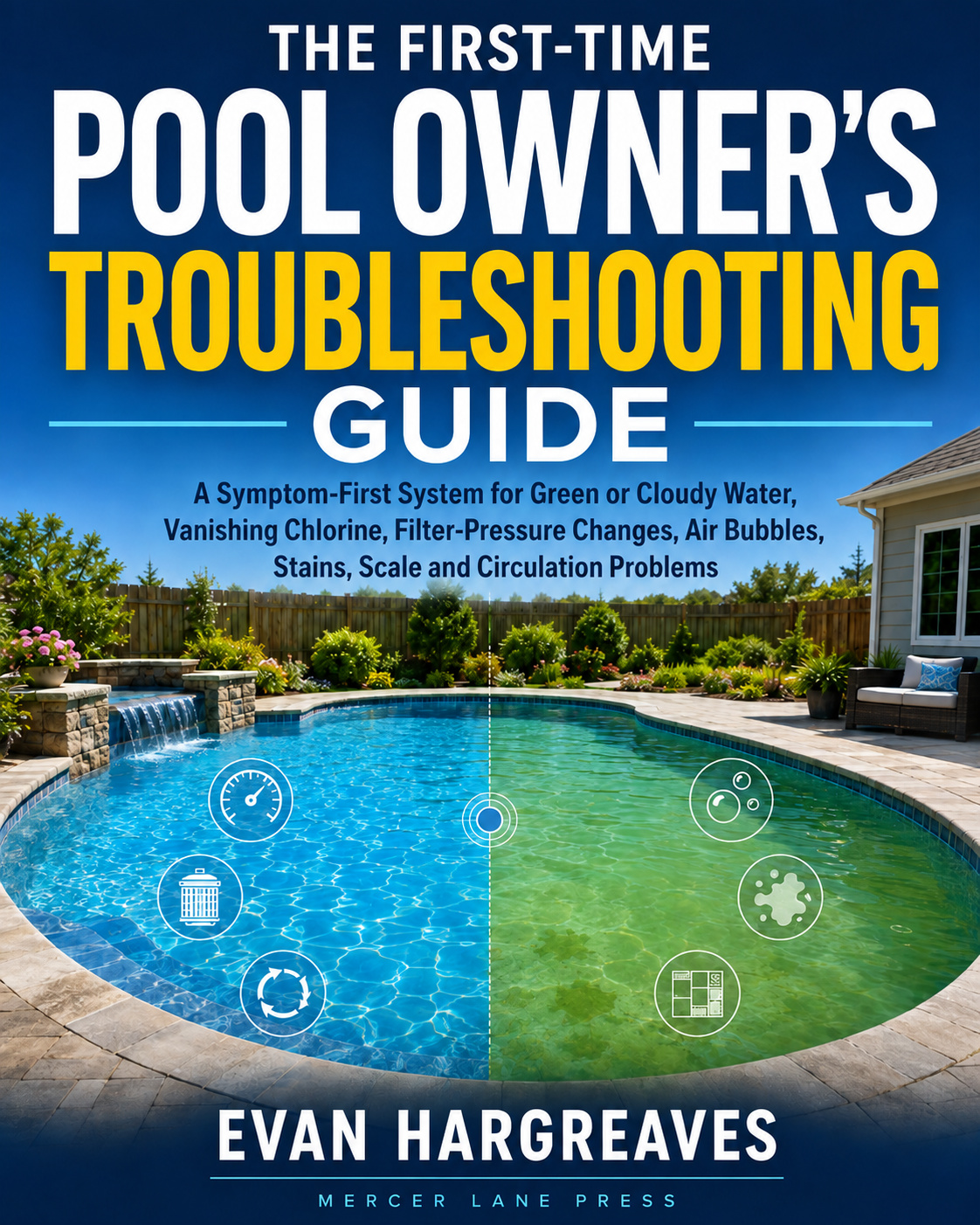
FIRST-TIME POOL OWNERSHIP
A Symptom-First System for Green or Cloudy Water, Vanishing Chlorine, Filter-Pressure Changes, Air Bubbles, Stains, Scale and Circulation Problems
By Evan Hargreaves · Published by Mercer Lane Press
A practical U.S.-focused troubleshooting guide for first-time residential pool owners, built around a symptom-first OBSERVE → TEST → ISOLATE → ACT → VERIFY method for water, circulation, filtration, equipment, recurring problems, seasonal transitions, and knowing when professional help is the correct next step.
WHO IT IS FOR
First-time and relatively new residential pool owners who need a structured way to investigate green or cloudy water, disappearing chlorine, pH drift, stains, scale, weak return flow, filter-pressure changes, persistent air, returning debris, pump changes, recurring algae, and seasonal or weather-related problems without guessing.
THE OPERATING SEQUENCE
The book is designed to replace guess-first corrections with a repeatable sequence. A symptom begins the investigation; it does not automatically choose the treatment.
Record what looks, sounds, feels, or tests differently, when the pool was last normal, and what happened between then and now.
Use water tests, filter pressure, return flow, air, and equipment state only when they help distinguish plausible causes. Verify a surprising measurement before acting heavily on it.
Separate water condition and chemistry, circulation, filtration, and equipment or environmental load instead of assuming every visible problem is chemical.
Use the current product label and installed-equipment instructions. Avoid changing several variables at once when one change can give you the next piece of evidence.
A treatment is not a result. Recheck appearance, sanitizer stability, pressure, flow, air, and recurrence until the expected condition has returned and remains stable.
Good troubleshooting can end with a clear professional handoff when internal equipment, electrical, gas, structural, pressure, hazardous-chemical, or other specialist work remains.
SYMPTOM-FIRST COVERAGE
Green or cloudy water, chlorine loss, pH drift, stains, scale, and combinations where the same appearance can arise from different causes.
Weak returns, higher or lower filter pressure, suction-side air, loss of prime, returning debris, and pump behavior interpreted against the pool's own baseline.
Algae that returns, test results that conflict with appearance, failed corrections, and the recovery order when several things go wrong at once.
Opening, closing and winterizing, leaving the pool unattended, returning after time away, and recovering after storms or major weather events.
Symptom, test-result, and equipment-behavior finders designed for the moment when something is wrong and the next useful check matters more than reading a chapter in sequence.
A pool baseline, troubleshooting log, product and equipment record, and professional handoff sheet turn memory into usable evidence.
FREE SUPPORTING GUIDES
Each guide below isolates one high-friction symptom and links it back to the same evidence-first troubleshooting system.
POOL TROUBLESHOOTING
Green water is a symptom, not a diagnosis. Separate green-and-cloudy water from clear green water and surface growth, then connect the observation to sanitizer, circulation, filtration, and recent changes.
Read the guidePOOL TROUBLESHOOTING
Cloudiness can come from several systems. Use the timeline, sanitizer and pH, return flow, filter pressure, pump state, and recent events to decide where the strongest evidence points.
Read the guidePOOL TROUBLESHOOTING
Low chlorine is a result, not a complete diagnosis. Record when the loss happens, verify the measurement, confirm sanitizer supply, then investigate demand and operating conditions.
Read the guidePOOL TROUBLESHOOTING
There is no useful universal pressure number for every pool. Compare current pressure with the clean baseline under the same operating condition, then read the change with flow and air.
Read the guidePOOL TROUBLESHOOTING
A few startup bubbles can be normal. Persistent bubbles are evidence that air is entering or remaining in the circulation system, often on the suction side.
Read the guidePOOL TROUBLESHOOTING
Heavy rain, wind, debris, power outages, and severe weather can affect several pool systems at once. Re-establish the pool in a safe order instead of treating water appearance first.
Read the guideSAFETY BOUNDARY
The book repeatedly separates owner-safe observation and routine maintenance from work that should stop or move to qualified help. It does not replace product labels, equipment-manufacturer instructions, local requirements, or professional advice.
SEARCH BY THE PROBLEM
Common pool searches include cloudy pool water, green pool water, chlorine that keeps disappearing, high filter pressure, air bubbles and weak return flow. The guide helps first-time owners separate water, circulation, filtration and equipment clues before changing several things at once.