Foundation
Stabilize Home Assistant, the local network, accounts, backups, and the basic recovery path before adding complexity.
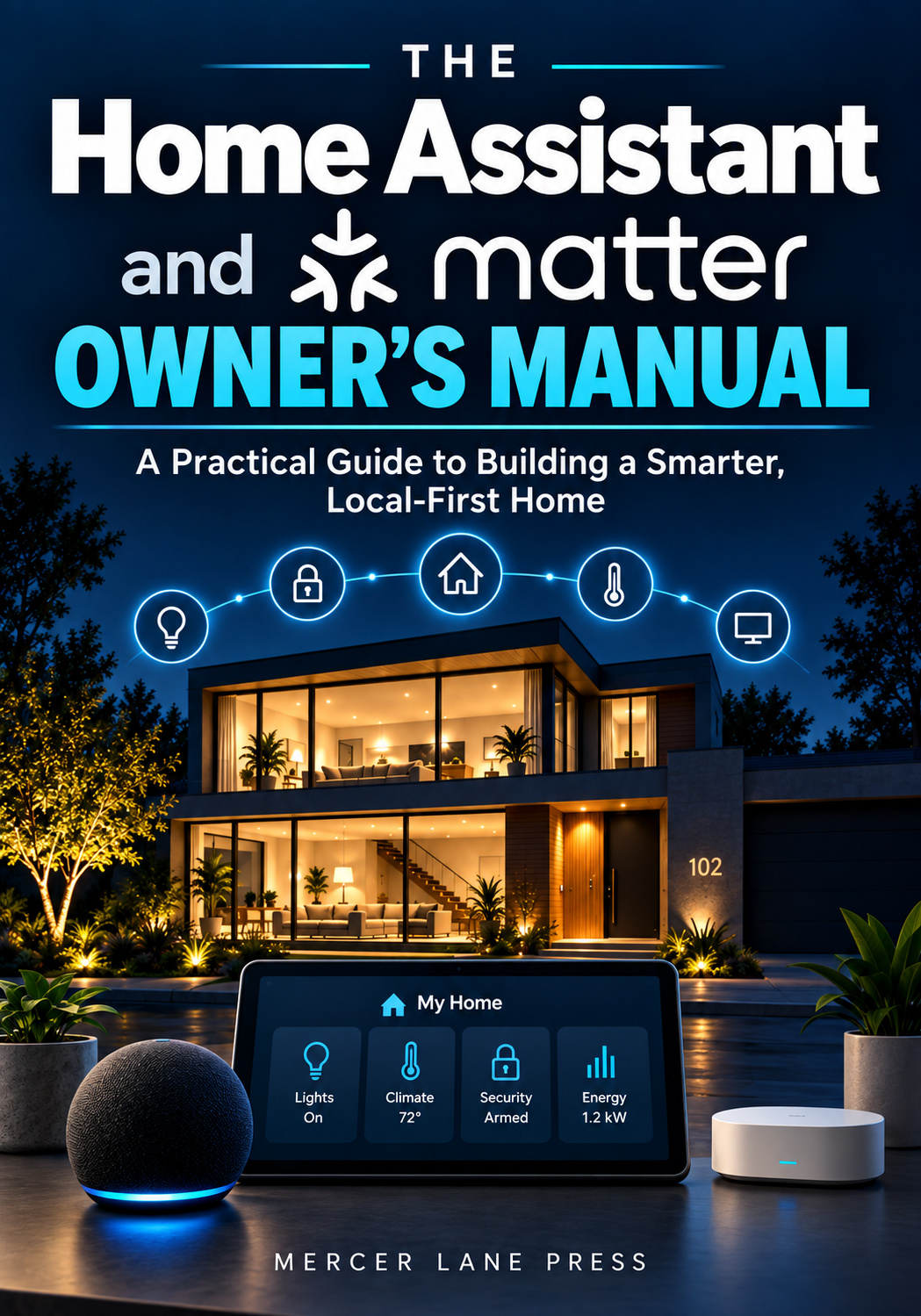
HOME ASSISTANT · MATTER · THREAD
A Homeowner’s Guide to Reliable Devices, Thread Networks, Private Automations, and Smart-Home Troubleshooting - Without Becoming a Programmer
By Lewis Hartfield · Published by Mercer Lane Press
A practical homeowner-focused operating manual for building and maintaining a reliable Home Assistant smart home, with Matter and Thread treated as separate layers, local-first control paths, conservative automation design, and structured troubleshooting.
WHO IT IS FOR
Homeowners who want Home Assistant, Matter, Thread, and mixed smart-home ecosystems to work reliably without turning the house into a permanent software project or requiring advanced YAML, MQTT, Node-RED, custom front-end development, or advanced network engineering.
THE OPERATING MODEL
The book treats a dependable smart home as an operating system for the household rather than a collection of gadgets. Each new layer is proved before the next one is added.
Stabilize Home Assistant, the local network, accounts, backups, and the basic recovery path before adding complexity.
Choose devices by their real control path, then commission one known-good device at a time.
Use floors, areas, labels, human-readable names, and clear primary ownership so the system stays intelligible.
Build small rules around household jobs rather than chains of clever events or unnecessary code.
Check that triggers, conditions, actions, and physical outcomes actually happened instead of assuming a command succeeded.
Back up, update, replace devices, review dependencies, and rehearse recovery like any other household system.
DIAGNOSE BY LAYER
Power, battery, firmware, reset state, sleeping behavior, and the physical function come first.
Wi-Fi, Ethernet, Thread, Zigbee, Z-Wave, Bluetooth, or a vendor bridge provide the path. Matter does not replace this layer.
Local IP, IPv6, multicast, phone reachability, and network isolation can decide whether a healthy device can be found and commissioned.
Home Assistant integrations, Matter controllers, fabrics, and bridges determine how the platform sees and controls the endpoint.
Only after manual control is reliable should triggers, conditions, actions, dashboards, and traces become the main suspects.
Preserve diagnostics, identify the first uncertain layer, make one change, then verify the result before resetting anything else.
MATTER & THREAD WITHOUT THE MYTHOLOGY
Home Assistant can commission and control Matter devices through its Matter controller path. A controller is not automatically a Thread Border Router.
A fabric is the trust and administration relationship between controller and commissioned devices. Multi-admin can place one device on more than one fabric when supported.
A Border Router connects a Thread mesh to the home IP network. Matter-over-Thread needs that route; Matter-over-Wi-Fi does not.
The book compares local native integrations, Matter paths, and mature bridges instead of assuming the newest standard always exposes the best feature set.
Several Border-Router-capable products do not automatically mean one understandable mesh. Credentials and actual network membership matter.
The first Matter device is treated as an acceptance test: name it, assign it, prove manual control, restart relevant infrastructure, and live with it before adding a fleet.
AUTOMATE WITHOUT TURNING THE HOUSE INTO SOFTWARE
Describe what should happen in ordinary language before opening the automation editor. If the rule cannot be explained clearly, more logic rarely helps.
Wall switches, thermostats, locks, and ordinary physical controls remain part of the system. Good automation should degrade toward a usable ordinary home.
For actions that can fail silently, trustworthy device state can confirm the result and trigger an escalation instead of claiming success too early.
Consequential rules should decide what missing data means rather than silently converting an unavailable sensor into a convenient assumption.
Ask whether the rule triggered, which condition passed or blocked it, which action ran, and what state the target reported afterwards.
Household members need clear controls and states; the maintainer needs batteries, updates, diagnostics, logs, and fault evidence.
OPERATE IT LIKE A HOUSEHOLD APPLIANCE
The maintenance sections cover off-device backups, recovery credentials, change-boundary backups, update checklists, firmware and infrastructure changes, device replacement cards, local-versus-cloud dependencies, privacy and security, and a 30-day reliability build. The worked household patterns apply the same ideas to lighting, climate and energy, leak and door alerts, migration decisions, and failure tests.
FREE SUPPORTING GUIDES
HOME ASSISTANT · MATTER · THREAD
The Matter logo does not tell you which network a device uses. Identify the transport first, then check the controller, Border Router, local network, and feature path you actually need.
Read the guideHOME ASSISTANT · MATTER · THREAD
Define the exact symptom, preserve evidence, identify the transport, check local reachability and controller state, and change one layer at a time before destructive resets.
Read the guideHOME ASSISTANT · MATTER · THREAD
A Border Router connects Thread to the home IP network. Reliability depends on the intended Thread network, shared credentials, physical mesh coverage, and a working local path to the Matter controller.
Read the guideHOME ASSISTANT · MATTER · THREAD
Start from a household sentence, prove manual control first, use clear conditions and helpers, preserve a manual exit, and verify consequential actions where reliable state feedback exists.
Read the guideHOME ASSISTANT · MATTER · THREAD
Treat a backup as a recovery path you can find and restore, create backups at change boundaries, update one layer at a time, and document replacement and recovery before failure.
Read the guideHOME ASSISTANT · MATTER · THREAD
Internet access is not the same as local reachability. Matter can use IPv6 inside the home even when the internet service is ordinary IPv4, and discovery can fail when isolation or segmentation blocks the local path.
Read the guideSAFETY BOUNDARY
Smart-home devices can affect mains electricity, heating, access, alarms, water, and appliances. Follow manufacturer instructions and applicable electrical and building rules, use qualified professionals where required, preserve independent safety controls, and do not make a hobby automation the sole control for a life-safety function.
SEARCH BY THE PROBLEM
Current Home Assistant support searches repeatedly involve Matter commissioning failures, Matter-over-Thread devices becoming unavailable, Thread border routers, IPv6 and discovery. The guide separates device, network, discovery, controller and automation layers so resets are not the first move.