Read the escalation curve
Use a five-zone observation scale and the dog's own early, middle, and late signs so action can happen before the hardest behavior appears.
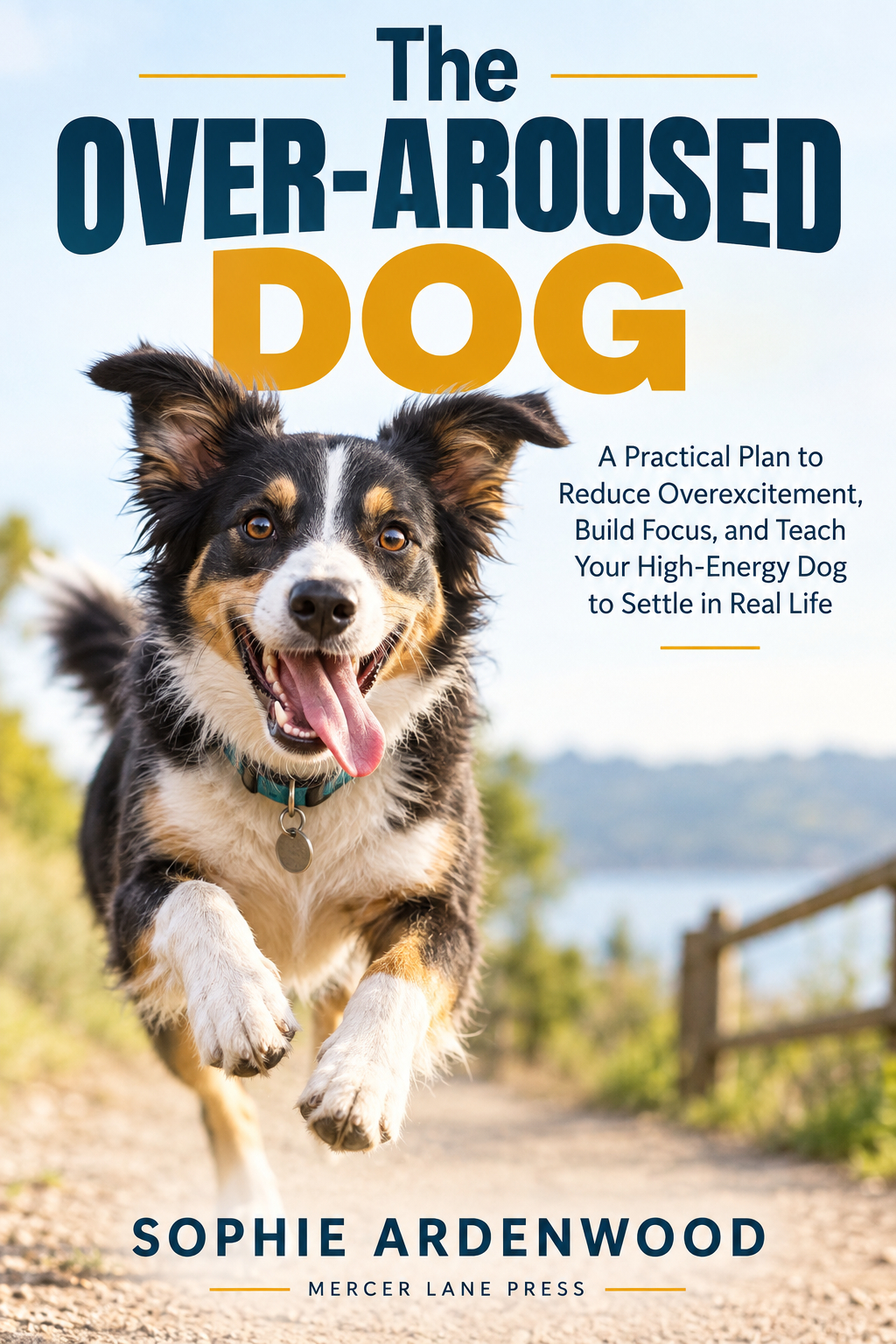
DOG SETTLING & OVER-AROUSAL GUIDE
A Practical Plan to Reduce Overexcitement, Build Focus, and Teach Your High-Energy Dog to Settle in Real Life
By Sophie Ardenwood · Published by Mercer Lane Press
A practical, reward-based guide for owners of high-energy and easily over-aroused dogs, combining lower-load daily routines, early-warning and recovery tracking, usable calm skills, and gradual practice around visitors, walks, play, public places, handling, and other real-life situations.
WHO IT IS FOR
Owners of dogs that become fast, noisy, mouthy, fixated, jumpy, demanding, difficult to disengage, or unable to settle after exciting or stressful events, including households trying to understand whether excitement, frustration, fear, fatigue, unmet needs, discomfort, or accumulated stimulation may be contributing to the pattern.
THE CORE METHOD
The book treats calmness as a set of workable behaviors and recovery skills rather than a personality change. The aim is not to remove normal enthusiasm, but to help the dog move between activity and recovery more successfully.
Use a five-zone observation scale and the dog's own early, middle, and late signs so action can happen before the hardest behavior appears.
Record context, starting state, intensity, behavior, response, and time back to baseline so patterns are easier to see across the whole day.
Review exercise after-effects, sniffing and enrichment, rest, transitions, window and doorway rehearsal, and other sources of accumulated load.
Use clear reinforcement, calm capture, mat work, brief attention skills, disengagement, and tiny pauses that are easy enough for the dog to succeed.
Work through visitors, walks, play, adolescence, cars, cafés, classes, grooming, and other high-load settings by changing one important variable at a time.
Measure frequency, intensity, workable distance or duration, ability to eat or sniff, and recovery time rather than expecting a dog to be calm all day.
PRACTICAL PLAN & TOOLKIT
Set a baseline, reduce unnecessary rehearsal, build home skills, add controlled difficulty, then apply the system to three specific real-life targets.
Use an arousal event log, early-warning profile, trigger-distance record, daily balance check, activity after-effect tracker, settle-mat ladder, visitor plan, walk-readiness check, progress review, and one-page calm plan.
Use six common over-arousal patterns, worked plans, mistake checks, quick-start reset material, micro-protocols, household consistency sheets, and a decision sequence when the next step is unclear.
FREE SUPPORTING GUIDES
OVER-AROUSED DOG
Build an early-warning list for your own dog, act while behavior is still flexible, and use recovery time as part of the picture instead of judging only the final reaction.
Read the guideOVER-AROUSED DOG
Use a short event record and a 24-hour review to find what predicts activation, what intensifies it, what helps recovery, and what is changing over time.
Read the guideOVER-AROUSED DOG
Use exercise after-effects, protected recovery windows, lower-stimulation transitions, and one-variable routine experiments to make settling more possible.
Read the guideOVER-AROUSED DOG
Teach the mat as a reinforced location first, then shift from simply going there to actually relaxing there before adding duration, movement, distractions, and new places.
Read the guideOVER-AROUSED DOG
Treat four weeks as an implementation framework rather than a promise: repeat or reduce a stage when the dog's recovery, flexibility, and ability to learn are not stable.
Read the guideSEARCH BY THE PROBLEM
Owners often search for an overstimulated dog that will not settle, trigger stacking, over-arousal or a high-energy dog that stays switched on. The guide helps separate excitement, frustration, fear, fatigue and accumulated stimulation before choosing the next step.