1. Copy the prompt
Begin from a structured prompt for the job instead of rebuilding the instruction from scratch each time.
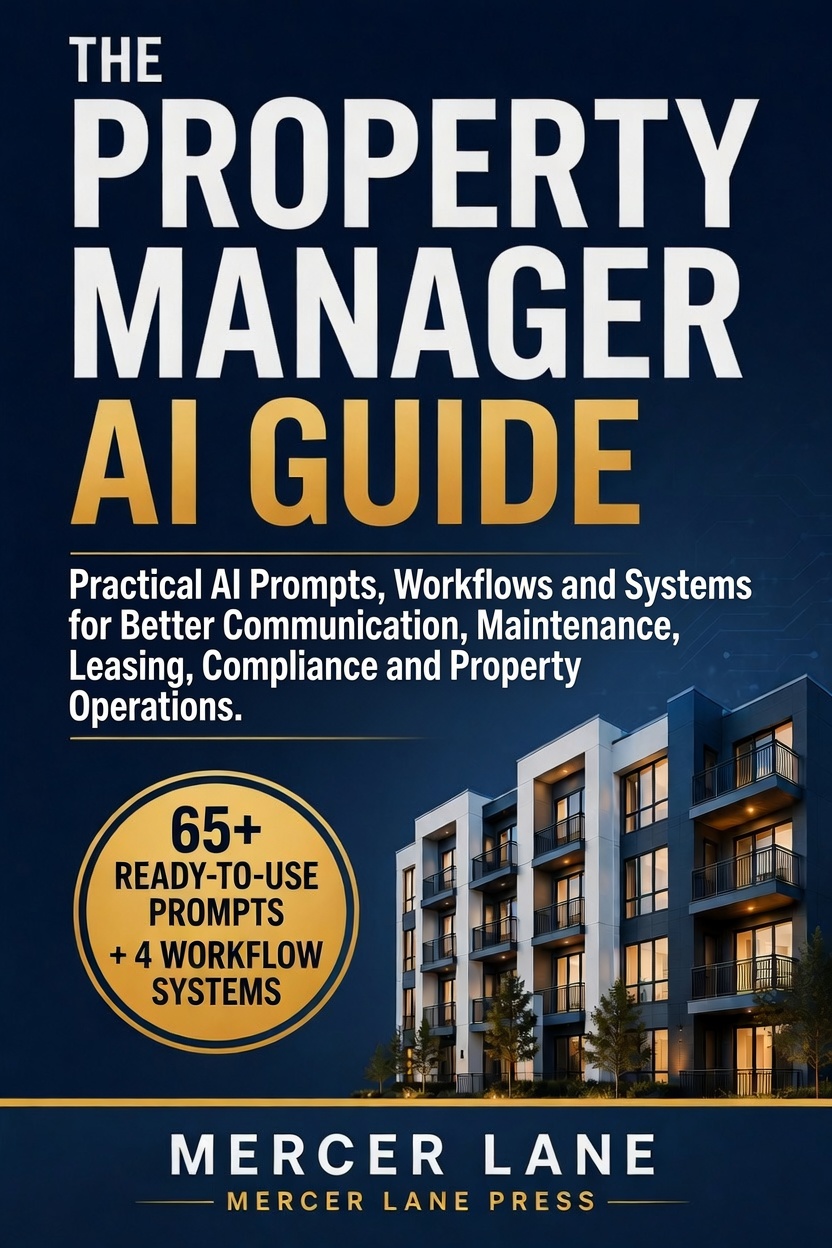
AI FOR PROPERTY MANAGEMENT
Practical AI Prompts, Workflows and Systems for Better Communication, Maintenance, Leasing, Compliance and Property Operations
By Mercer Lane · Published by Mercer Lane Press
A practical guide to using AI for recurring property-management communication and operations, with structured prompt methods, workflow systems, action plans, privacy precautions, and implementation routines across tenant communication, maintenance, leasing, rent collection, documentation, owner reporting, planning, and conflict resolution.
WHO IT IS FOR
Independent property managers, small property-management companies, and in-house residential managers who want a repeatable way to use AI for routine drafting, coordination, reporting, documentation, and planning while keeping human review and local requirements in the loop.
THE FOUR-STEP WORKING METHOD
The book treats prompts as reusable working tools rather than one-off questions. Start with a prepared prompt, place it in the AI tool you use, replace the bracketed placeholders with the facts of the situation, then review the draft before using it.
Begin from a structured prompt for the job instead of rebuilding the instruction from scratch each time.
The prompt structure is designed to work across major general-purpose AI chat tools rather than depending on one proprietary workflow.
Replace placeholders with the relevant names, unit, dates, amounts, issue details, tone, and other facts needed for that particular task.
Read the draft, correct anything that is inaccurate or unsuitable, adjust the tone if needed, and only then move it into the email, text, property-management system, or document where it belongs.
PROMPT STRUCTURE
One prompt formula runs through the book. It tells the AI who it should act as, what it needs to do, the facts it needs to work from, and the format the answer should take.
Set the working perspective, such as a property manager preparing a resident update or an operations assistant organizing a process.
State the exact job: draft the email, summarize the report, build the checklist, prepare the agenda, or organize the notes.
Provide only the facts needed to do the job well, including dates, amounts, relevant history, constraints, and tone.
Specify whether you need a short text, email, table, script, checklist, memo, or another usable format.
THE PROMPT LIBRARY
The manuscript groups the working prompts around the communication and operations tasks that recur across residential property management.
Reminders, welcomes, renewals, complaint responses, service recovery, and other recurring resident messages.
Acknowledgments, work orders, triage, owner approvals, delay updates, inspections, and vendor follow-up.
Listing copy, showing confirmations, applicant communication, waitlists, open houses, and rental-comparison summaries.
Tiered late-rent communication, payment-plan drafts, deposit explanations, rent-roll summaries, and owner-facing analysis.
Structured drafts and internal records that still require the property manager to apply the correct local policy, law, and review process.
Monthly updates, capital-expenditure summaries, portfolio reporting, budget variances, and year-end communication.
Daily priorities, weekly schedules, turnover calendars, SOP drafts, meeting agendas, delegation, and wrap-up logs.
Preparation and follow-up for difficult conversations, tenant disputes, vendor disagreements, and de-escalation.
FOUR COMPLETE WORKFLOW SYSTEMS
Single prompts handle one drafting task. The workflow chapters show how several of those tasks connect so a recurring process can be handled in a consistent order.
Acknowledge the request, triage urgency, dispatch the vendor, obtain owner approval when needed, communicate delays, confirm resolution, and document significant events.
Read the maintenance workflow →Move from application approval through lease-signing coordination, welcome communication, move-in preparation, and a tenant-file completeness check.
Use a staged communication sequence, document each step, and keep formal notices and jurisdiction-specific action inside the appropriate legal/compliance review process.
Read the rent follow-up guide →Connect pricing review, listing creation, multi-channel promotion, showing confirmations, applicant communication, and the handoff into tenant onboarding.
PRIVACY, ACCURACY & REVIEW
Most routine drafting does not require full legal identities, complete addresses, financial-account details, screening reports, medical information, or other highly sensitive records. Use the smallest amount of information that still supports the task.
Read the privacy guide →AI can produce inaccurate or unsuitable wording. Read the result before sending it, correct factual errors, and keep the property manager responsible for the final communication.
Notices, eviction steps, Fair Housing matters, accommodation decisions, deposit rules, fees, and other jurisdiction-dependent issues need the correct local process and appropriate legal or compliance review.
IMPLEMENTATION
Choose a primary tool, use the highest-frequency prompt categories regularly, and put one complete maintenance workflow into practice.
Run a full vacancy workflow, begin saving your customized prompts, and bring structured AI assistance into owner reporting.
Add prompt chaining and tone presets, build owner reference sheets where relevant, compare selected operating metrics with your baseline, and fill gaps in the personal prompt library.
FREE SUPPORTING GUIDES
These companion articles turn five high-value parts of the book into focused reference pages without reproducing the prompt library itself.
PROPERTY MANAGER AI
When an AI draft is vague, the problem is often the instruction. Use four fields—Role, Task, Context, and Output—to make recurring property-management prompts easier to reuse and review.
Read the guidePROPERTY MANAGER AI
Maintenance requests create several communication handoffs. Use one repeatable sequence so the tenant, vendor, owner, and internal record stay aligned from intake to close-out.
Read the guidePROPERTY MANAGER AI
Most routine property-management drafting needs less personal information than a full file contains. Minimize, anonymize, check policy, and keep sensitive decisions in the proper systems.
Read the guidePROPERTY MANAGER AI
AI can help keep rent follow-up consistent, but it should not invent notice periods, fees, deadlines, rights, or legal consequences. Separate communication support from the formal legal process.
Read the guidePROPERTY MANAGER AI
Do not introduce every AI use case at once. Spend the first month on repeatable drafting, the second on connected workflows and a personal prompt library, and the third on refinement and measurement.
Read the guideSEARCH BY THE PROBLEM
Searches for AI for property managers and ChatGPT prompts for property management often centre on tenant messages, maintenance coordination, leasing, owner reports and repetitive documentation. This guide turns those tasks into repeatable, reviewable workflows.