Spot the five seconds before the reaction
Learn your dog's normal walking baseline and act on early changes before barking or lunging begins.
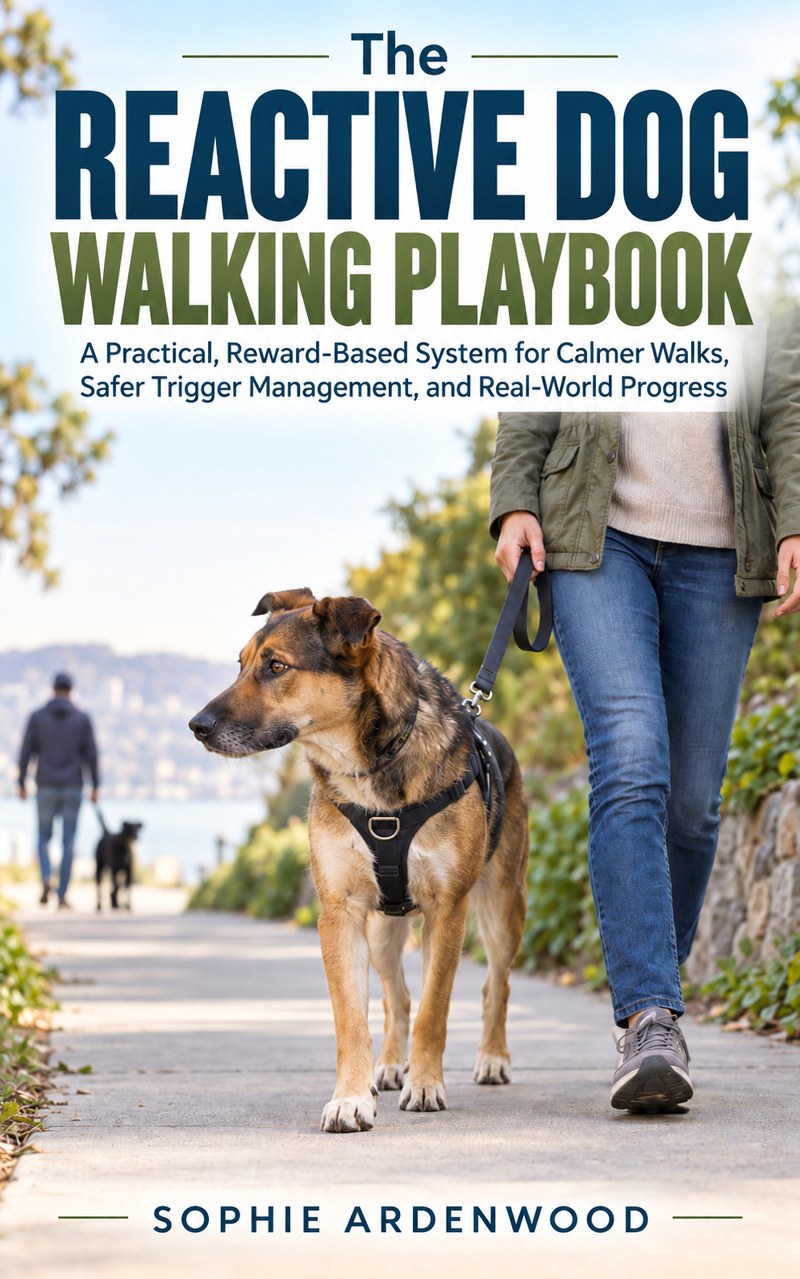
REACTIVE DOG WALKING GUIDE
A Practical, Reward-Based System for Calmer Walks, Safer Trigger Management, and Real-World Progress
By Sophie Ardenwood · Published by Mercer Lane Press
A practical, reward-based guide to making reactive-dog walks more manageable by spotting early warning signs, creating distance sooner, rehearsing exits, planning routes, and tracking recovery and progress.
WHO IT IS FOR
Dog owners and handlers dealing with barking, lunging, freezing, hard staring, or other reactive behavior on walks who want a structured, reward-based way to make safer decisions.
INSIDE THE PLAYBOOK
The book treats reactivity as an observable response rather than a diagnosis. The practical system uses body-language changes, trigger context, distance, recovery, and the dog's ability to move, eat, sniff, and disengage to guide decisions.
Learn your dog's normal walking baseline and act on early changes before barking or lunging begins.
Record the context that makes an encounter easier or harder and use distance as the main difficulty control.
Build orientation, a moving hand target, food search, and a practiced turn-away in easy places first.
Turn, cross, retreat, or use a visual barrier when a trigger arrives faster than the training plan.
Reduce avoidable rehearsal, install the core skills, and gather enough data to choose the first structured training target.
Change one major variable at a time and track distance, reactions, recovery, route flexibility, and handling load.
REFERENCE TOOLS
A day-by-day sequence covering equipment, skills, trigger mapping, easy walks, planned observation, and review.
Real-world decision sequences for head-on dogs, blind corners, loose dogs, runners, traffic, hallways, gates, elevators, crowded sidewalks, and more.
Use trigger, distance, early signs, outcome, and recovery to make the next walk easier rather than relying on memory.