Vehicle register
Give every vehicle a stable Unit ID and keep the identity, status, current mileage, maintenance source, assignment, and document location together.
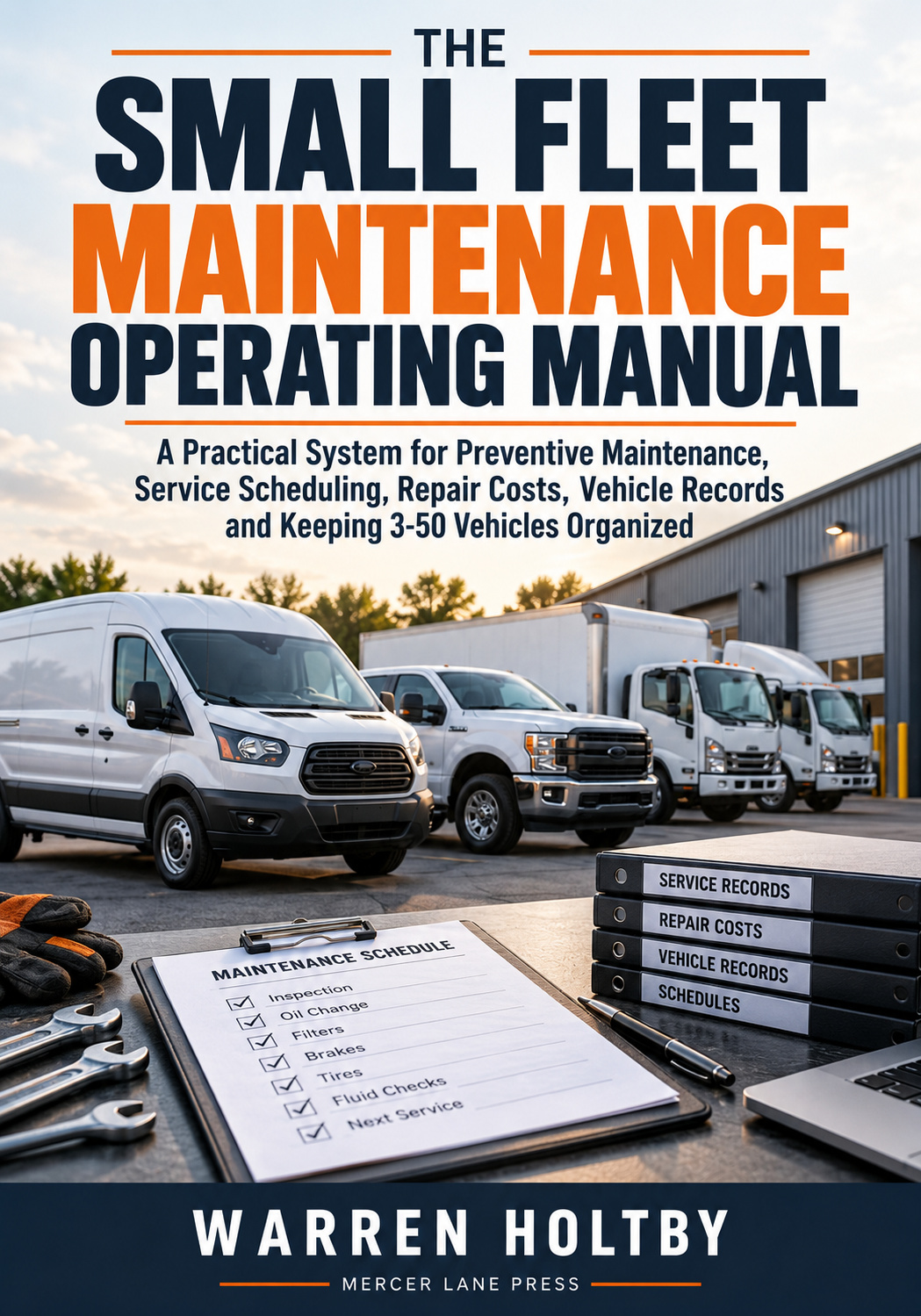
SMALL FLEET MAINTENANCE & OPERATIONS
A Practical System for Preventive Maintenance, Service Scheduling, Repair Costs, Vehicle Records and Keeping 3-50 Vehicles Organized
By Warren Holtby · Published by Mercer Lane Press
A practical administrative system for small fleets that connects vehicle records, source-backed maintenance rules, due and overdue scheduling, defect and repair actions, service history, repair costs, downtime, review routines, and a 30-day implementation plan.
WHO IT IS FOR
Owners, managers, administrators, and maintenance coordinators responsible for roughly 3-50 vehicles who need a dependable way to keep maintenance information, mileage, defects, repair approvals, invoices, costs, and follow-up from becoming scattered across memory, messages, calendars, and disconnected files.
THE CONTROL SYSTEM
The operating model links the asset, the maintenance requirement, the due trigger, the next action, completion evidence, and the review of exceptions.
Give every vehicle a stable Unit ID and keep the identity, status, current mileage, maintenance source, assignment, and document location together.
Record what each vehicle requires, where the requirement came from, the trigger type, the last supported baseline, and the next due point.
Separate requirement, status, and action so DATA ISSUE, OVERDUE, DUE SOON, BOOKED, and CURRENT remain visible for the right reasons.
Turn observations into controlled records with an owner, next action, target date, approval path, and documented disposition.
Close completed work with date, mileage, vendor, cost, evidence, linked actions, recommendations, and the correct next-due reset.
Use weekly, monthly, and quarterly views to focus attention on overdue work, stale data, open actions, downtime, repeat events, cost changes, and replacement-review candidates.
DECISION-USEFUL RECORDS
The book keeps planned and unplanned work, downtime, repeat events, source confidence, and repair-versus-replace evidence distinct so a single number does not become a false verdict.
IMPLEMENTATION
Build separate tables for vehicles, mileage, rules, defects/actions, service history, downtime, settings, audit checks, and dashboard exceptions.
Test exact due points, missing mileage, dual triggers, stale data, late service, corrections, row additions, negative values, and other edge cases before trusting the status output.
Define ownership, reconcile active vehicles, verify maintenance sources, launch the due board and mileage routine, add repair control and cost history, then stress-test and freeze Version 1.
The system organizes maintenance administration. It does not invent vehicle-specific service intervals, diagnose faults, or replace manufacturer information, qualified mechanical advice, warranty requirements, recall instructions, or the legal and regulatory rules that apply to a particular operation.
FREE SUPPORTING GUIDES
FLEET MAINTENANCE
Build a closed maintenance-control loop so each vehicle requirement becomes visible, owned, completed, recorded, and reviewed.
Read the guideFLEET MAINTENANCE
Build the spreadsheet as connected tables, then make missing data, dual triggers, due-soon windows, and formula logic visible and testable.
Read the guideFLEET MAINTENANCE
Capture observations, assign the next action, control authorization, retain evidence, and close the loop only after the record is ready for the future.
Read the guideFLEET MAINTENANCE
Use consistent cost definitions and downtime evidence to identify vehicles that need review without relying on a universal repair-cost threshold.
Read the guideFLEET MAINTENANCE
Prioritize forward visibility first: define ownership, reconcile vehicles, verify rules, launch the exception schedule, then add closure, cost, dashboard, and QA.
Read the guideCalculate one verified maintenance rule by date or mileage with the free browser tool. For recurring records across several vehicles, explore the Small Fleet Maintenance System, a separate Excel workbook and forms product. The book teaches the method; the digital product supplies working files. The book is sold separately.
SEARCH BY THE PROBLEM
Small-fleet operators commonly search for fleet maintenance schedules, preventive-maintenance checklists, mileage tracking and maintenance spreadsheets. The book focuses on controlling due work, defects, repair history and vehicle availability rather than relying on memory.