QUALIFY
Decide whether a location deserves deeper investigation using repeat population, purchase occasions, convenience, placement, access, security, host alignment, route fit, and evidence quality.
VENDING · SMALL ROUTE OPERATIONS
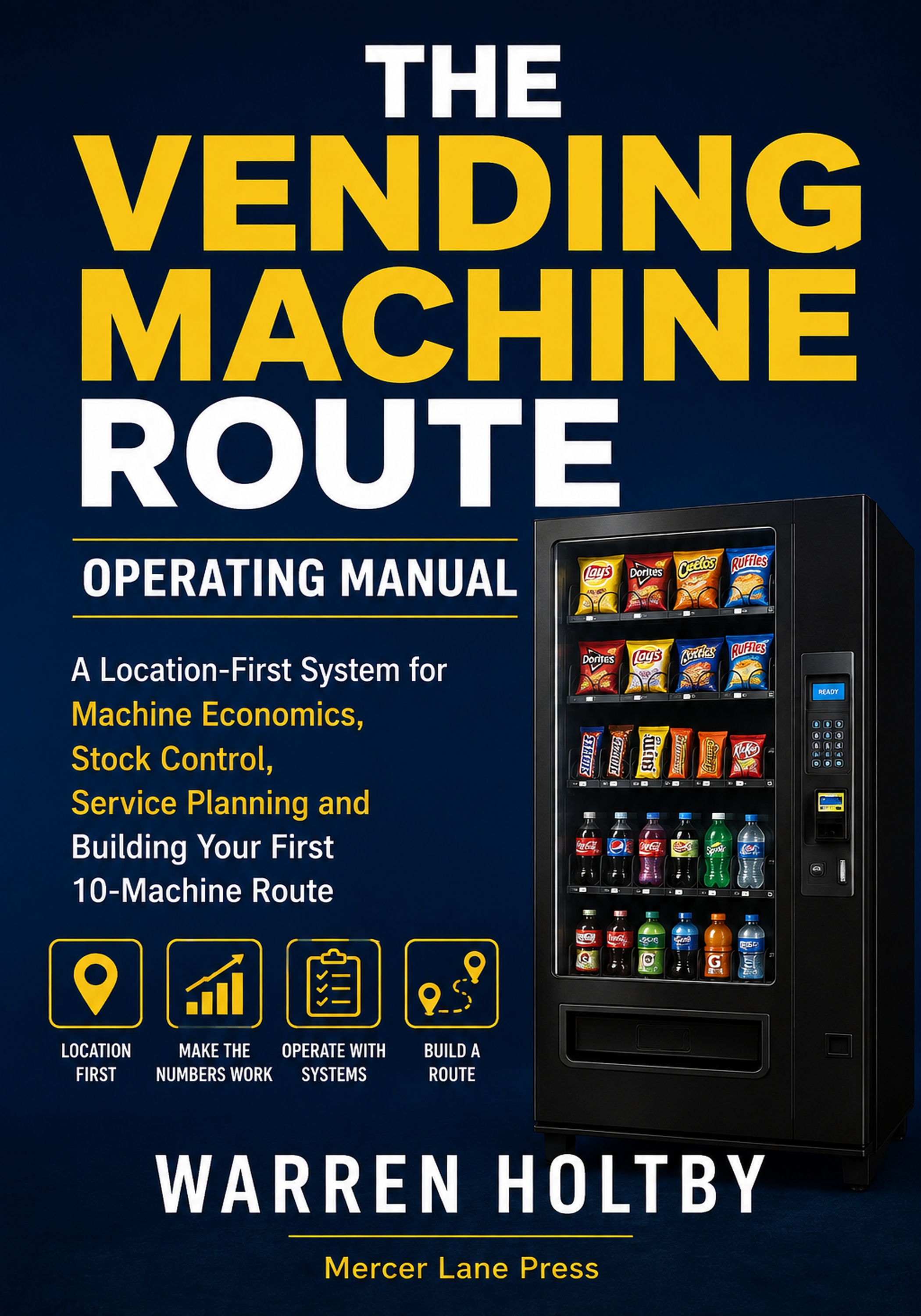
A Location-First System for Machine Economics, Stock Control, Service Planning and Building Your First 10-Machine Route
By Warren Holtby · Published by Mercer Lane Press
A practical U.S.-focused operating manual for people building or running a small vending-machine route, using a location-first system to qualify sites, model machine economics, choose equipment, control stock and service, measure each machine, and scale from the first machine toward a controlled ten-machine route.
WHO IT IS FOR
People considering their first vending machine, new operators building a small route, and owners of early-stage routes who want a repeatable way to qualify locations, understand machine-level economics, manage stock and service, review underperforming equipment, evaluate route purchases, and grow without relying on memory.
THE OPERATING CYCLE
The manual starts before the machine purchase. The equipment should serve a qualified opportunity; the opportunity should not be invented to justify equipment already owned.
Decide whether a location deserves deeper investigation using repeat population, purchase occasions, convenience, placement, access, security, host alignment, route fit, and evidence quality.
Rebuild the economics below gross sales and test weak, base, and strong operating cases before committing capital.
Choose equipment that fits the customer, the physical site, the operator, and the economics instead of letting an available machine define the opportunity.
Survey the site, clarify access and responsibilities, agree workable commercial terms, and verify relevant requirements before installation.
Treat the first fill as a hypothesis, set deliberate par levels, and change product space from repeated evidence rather than preference.
Visit because the machine needs useful attention, prepare stock before departure, and separate urgent, due, optional, and not-due stops.
Track machine contribution, route hours, stockouts, faults, downtime, host condition, and trend so each machine produces evidence.
Keep, improve, renegotiate, replace, relocate, or exit as the evidence changes; machine count alone is not the scoreboard.
FROM ONE MACHINE TO TEN
Learn the service sequence, keep current records, reconstruct the machine economics, understand pars, and identify the main unresolved risk before treating a second machine as progress.
Keep machine-specific product and service decisions while standardizing records, payment checks, complaint handling, and other operating mechanics.
Make geography, central inventory, route preparation, emergency-pattern review, and equipment serviceability explicit rather than allowing complexity to grow invisibly.
Move machine, host, terms, payment, service, fault, economics, route-hour, and next-action information into an external route record.
WORKSHEETS & OPERATING TOOLS
The book collects practical route-management sheets at the back for personal business use.
Initial Route Definition, Location Candidate Record, Location Go / No-Go Scorecard, Machine Economics Worksheet, Commission Sensitivity Table, All-In Acquisition Cost Sheet, Equipment Match Sheet, and Used-Machine Inspection Checklist.
Cashless Readiness Check, Location Prospect Tracker, Site Survey, Agreement Issue Checklist, Compliance Verification Record, First-Fill Planner, Par-Level Sheet, SKU Decision Matrix, Price Review, and Standard Service Checklist.
Service Interval Review, Route Stop Performance Table, Route Planning Sheet, Monthly Machine Scorecard, Underperformance Review, relocation and acquisition tools, scale gates, a Ten-Machine Scoreboard, and a Ten-Machine Operating Audit.
FREE SUPPORTING GUIDES
VENDING MACHINE ROUTES
A busy property is not automatically a good vending site. Start with why people would buy there, then test the site, placement, terms, service burden, and quality of the evidence.
Read the guideVENDING MACHINE ROUTES
Gross sales are useful but incomplete. Rebuild machine contribution, test weak, base, and strong cases, and compare the result with the full installed cost of the equipment.
Read the guideVENDING MACHINE ROUTES
A used-machine inspection cannot eliminate every future repair, but it can reduce avoidable surprises and stop a low purchase price from hiding a weak deployed asset.
Read the guideVENDING MACHINE ROUTES
Treat the first fill as a hypothesis. Record what sold and what remained, adjust par deliberately, and use KEEP, EXPAND, TEST, or REPLACE decisions across comparable service cycles.
Read the guideVENDING MACHINE ROUTES
A route should answer which machines need attention, in what order, and what stock each one needs. Fixed weekly visits are a starting habit, not a permanent rule.
Read the guideVENDING MACHINE ROUTES
A route listing can package strong and weak machines together. Verify what is being sold, rebuild each machine's economics, inspect the route, test host transfer risk, and define walk-away conditions.
Read the guideSCOPE & BOUNDARIES
The book is written for people operating or considering a small vending-machine route in the United States. It provides general educational information and does not replace legal, tax, accounting, investment, insurance, electrical, engineering, food-safety, or other qualified advice.
Financial figures in the book are hypothetical teaching examples. Actual sales, costs, service burden, repairs, payment fees, commissions, regulation, and profitability vary by operator and location. Current requirements and commercial terms should be verified before acting on them.
SEARCH BY THE PROBLEM
Searches for vending machine business ideas, best vending machine locations, vending route profit and route buying tend to focus on the machine first. This guide starts with location quality, unit economics, stock, service burden and route density.