OBSERVE
Describe what changed without deciding why: water appearance, fish behavior, equipment, or another visible difference.
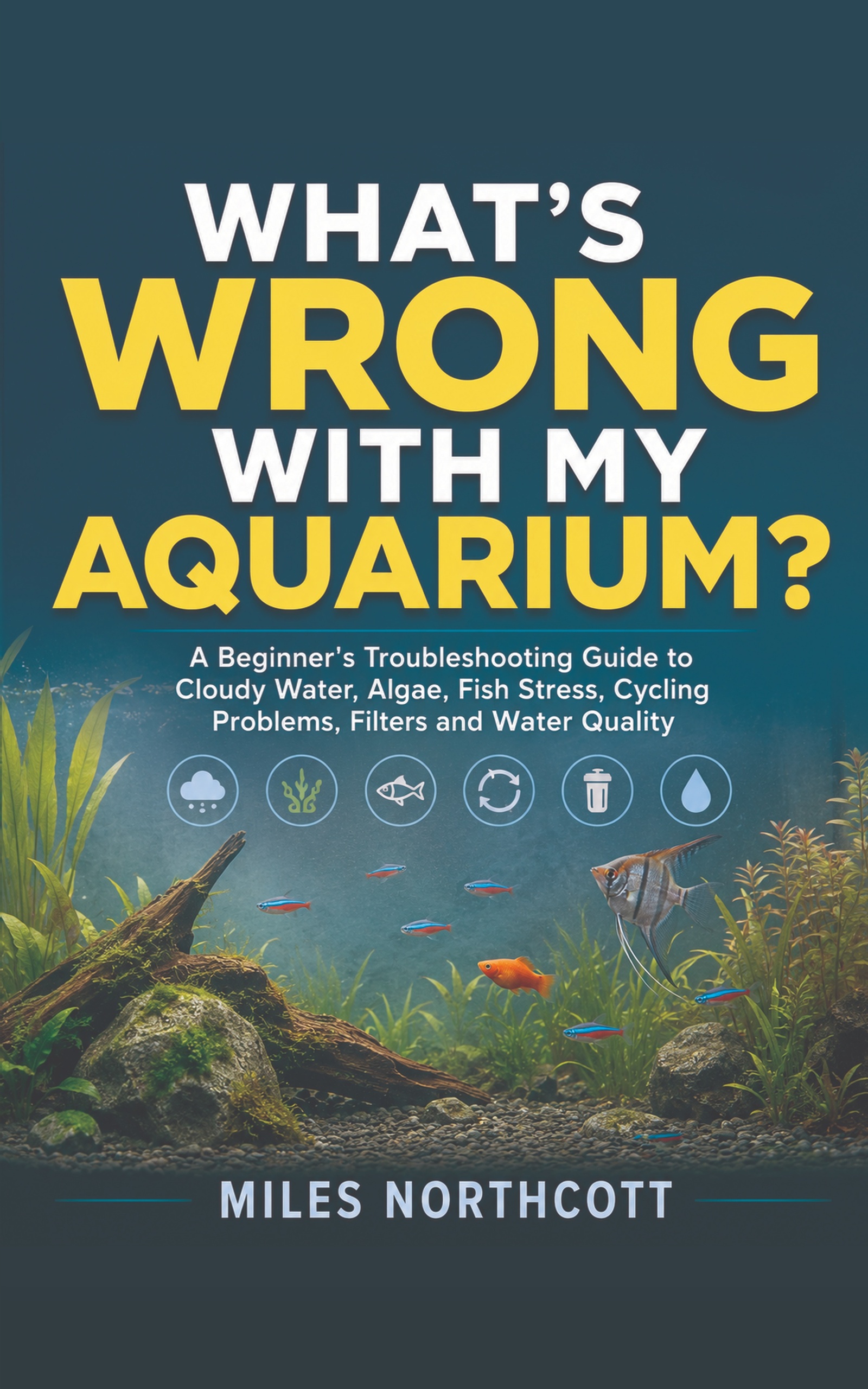
FRESHWATER AQUARIUM TROUBLESHOOTING
A Beginner's Troubleshooting Guide to Cloudy Water, Algae, Fish Stress, Cycling Problems, Filters and Water Quality
By Miles Northcott · Published by Mercer Lane Press
A beginner-focused freshwater aquarium troubleshooting guide built around an observe, test, triage, correct, and verify method. It helps owners investigate cloudy or green water, fish stress, cycling and water-quality problems, filter and temperature failures, water-change problems, recurring algae, feeding and stocking pressure, and decide when specialist or aquatic-veterinary help is appropriate.
WHO IT IS FOR
Beginner freshwater aquarium owners who already have a tank and need a practical way to work out what changed, what to check first, which measurements matter, how urgent the problem may be, and whether to correct, observe, or escalate.
THE TROUBLESHOOTING METHOD
The book is designed to prevent the common beginner mistake of changing several things before establishing what actually changed and what evidence supports the next step.
Describe what changed without deciding why: water appearance, fish behavior, equipment, or another visible difference.
Measure what can reduce uncertainty, especially actual temperature, ammonia, nitrite, and other parameters relevant to the aquarium.
Decide whether the issue is cosmetic, important, or potentially urgent before choosing a response.
Take the smallest justified action that addresses the evidence instead of changing several variables at once.
Check whether the fish, water, equipment, or measurement actually improved after the intervention.
THE CORE FIVE
Ask whether one fish is affected or several. Compare breathing, swimming, balance, position in the tank, appetite, and responsiveness.
Use an actual thermometer. A heater setting is not proof of the water temperature.
Check normal flow, surface movement, intakes, pumps, outages, and whether recent filter work changed the system.
Use the test results as evidence. An occupied aquarium with detectable ammonia or nitrite deserves investigation in context.
Reconstruct the last 48 hours and then the last seven days: water changes, filter cleaning, new fish, feeding, products, lighting, substrate disturbance, power loss, or source-water changes.
SYMPTOM-FIRST CHAPTERS
The book is intentionally non-linear. Readers can begin with the symptom finder, then move to the relevant chapter and back to the Core Five Checks.
White or cloudy water, green water, yellow or tea-colored water, surface film, foam, unusual smell, and floating debris.
Surface gasping, hiding, unusual inactivity, appetite loss, flashing, clamped fins, physical warning signs, and an unexplained death.
Reduced or stopped filter flow, temperature errors, problems after a water change, and problems after adding fish.
Recurring algae, moving water-test results, instability after cleaning, and the combined pressure of feeding and stocking.
Learn when a controlled observation period is safer and more informative than adding another unrelated change.
Recognize continuing deaths, severe breathing problems, significant physical abnormalities, suspected toxic exposure, and other situations that exceed home troubleshooting.
BUILD A TANK THAT IS EASIER TO DIAGNOSE
Learn normal fish behavior, usual temperature, filter flow, water-test pattern, and the tank's response to ordinary maintenance.
Keep tank profile, source water, livestock, maintenance, and water-test records simple enough that they still help when a problem appears.
“Added clarifier” is less useful than recording what you saw, what the tests showed, why the action made sense, and what happened afterward.
FREE SUPPORTING GUIDES
AQUARIUM TROUBLESHOOTING
Cloudy water describes an appearance, not a cause. Use tank age, visible particles, water tests, filter history, feeding, and recent maintenance to decide what the haze is telling you.
Read the guideAQUARIUM TROUBLESHOOTING
Several fish persistently gathering at the surface deserves prompt attention. Check whether the behavior is abnormal, then work through temperature, circulation, ammonia, nitrite, and recent changes.
Read the guideAQUARIUM TROUBLESHOOTING
A cycling problem is a mismatch between the waste entering the aquarium and the biological filtration currently able to process it. Use measurements and recent history rather than tank age alone.
Read the guideAQUARIUM TROUBLESHOOTING
A filter is not merely a dirt trap. Separate mechanical, biological, and chemical functions so maintenance restores flow without automatically discarding established biological filtration.
Read the guideAQUARIUM TROUBLESHOOTING
Recurring algae is more useful as a pattern than as a one-off nuisance. Track what happens before growth accelerates, then correct the strongest evidence-supported cause instead of repeatedly treating the visible result.
Read the guideIMPORTANT LIMITS
The book provides general educational and informational guidance. Aquarium conditions and fish requirements vary by species, water source, system design, and individual circumstances. It does not diagnose disease from a single behavior or photograph and it does not replace examination, diagnosis, or treatment by a qualified aquatic veterinarian.
Seek appropriate specialist or veterinary assistance when fish are severely distressed, deteriorating rapidly, experiencing repeated unexplained deaths, showing significant physical abnormalities, or when serious contamination or an equipment hazard is suspected.
SEARCH BY THE PROBLEM
Cloudy aquarium water, fish gasping at the surface, ammonia or nitrite during cycling, algae and filter problems are common symptom-led searches. This guide helps owners check the tank in a useful order and avoid treating appearance alone as a diagnosis.