Nights 1–5: Control
Practise focus, small mount movements, eyepiece choices, finder alignment, and naked-eye orientation before asking the telescope to do harder work.
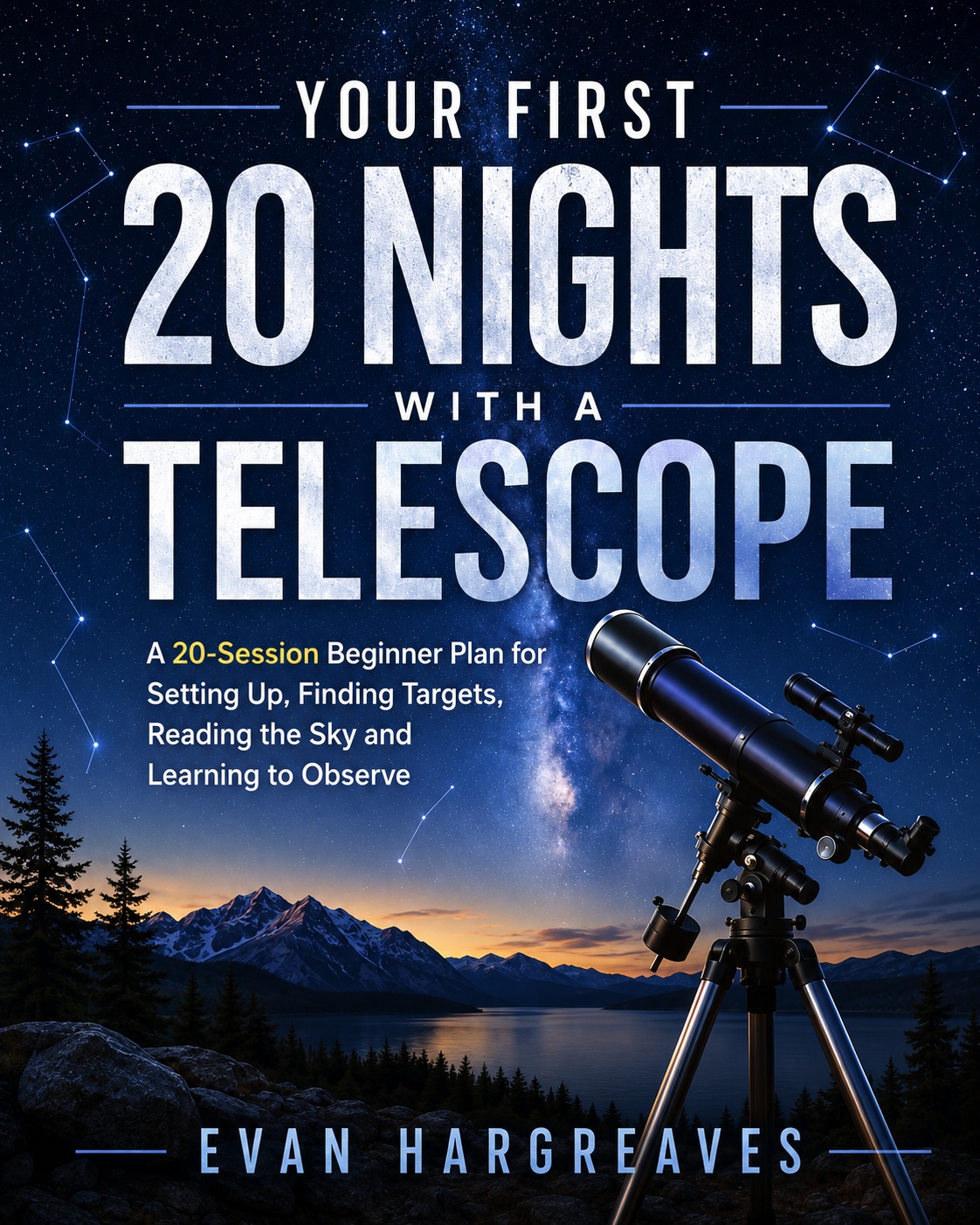
BEGINNER TELESCOPE OBSERVING
A 20-Session Beginner Plan for Setting Up, Finding Targets, Reading the Sky and Learning to Observe
By Evan Hargreaves · Published by Mercer Lane Press
A practical twenty-session beginner program for learning visual telescope observing: set up and control the instrument, find and confirm targets, build observing technique, read conditions, troubleshoot problems, and plan independent sessions.
WHO IT IS FOR
New telescope owners and beginner visual observers who want a structured sequence of real observing sessions instead of trying to learn equipment, sky navigation, target choice, and observing technique all at once.
THE TWENTY-SESSION PROGRESSION
The program adds one principal skill at a time, moving from guided equipment practice toward an observing session you can plan and run for yourself.
Practise focus, small mount movements, eyepiece choices, finder alignment, and naked-eye orientation before asking the telescope to do harder work.
Make a first star hop, split a double star, find an open cluster, study the Moon, and observe a planet with realistic expectations.
Learn the difference between seeing and transparency, protect dark adaptation, use averted vision, and compare nebulae, clusters, galaxies, and planetary nebulae.
Adapt to light pollution, compare a darker site, plan a three-object session, rescue a bad night, and finish with a session that is not dictated target by target.
Use the troubleshooting reference, magnification notes, condition checks, target pack, finder plates, session planner, field checks, observing logs, key terms, and final field card after the program.
Choose a next 90-day project such as the Moon, double stars, clusters, galaxies, planets, or another structured observing program, then build depth through repeated observation.
FIELD METHOD
A wide field makes it easier to recover a target, check the finder, and separate an aiming problem from a magnification problem.
Confirm focus, finder agreement, and normal mount movement before blaming a difficult faint object or changing several settings.
Seeing, transparency, moonlight, sky brightness, dew, target altitude, and local obstructions can change what a working telescope can show.
FREE SUPPORTING GUIDES
TELESCOPE OBSERVING
Start with a bright easy target and the lowest-power normal eyepiece. Move slowly through the focus range, pass the sharpest point once, then return to it so you learn what correct focus actually looks like.
Read the guideTELESCOPE OBSERVING
The main telescope is the reference. Centre a distant stationary object at low power, adjust the finder to the same point without moving the telescope, then move away and reacquire the object to prove the alignment.
Read the guideTELESCOPE OBSERVING
Magnification equals telescope focal length divided by eyepiece focal length. Start low, centre the target, refocus after each change, and keep higher power only when it reveals more useful detail.
Read the guideTELESCOPE OBSERVING
Star hopping is navigation by signposts. Start from something you can identify, make one short move at a time, confirm the pattern before continuing, and return to the last known position as soon as certainty breaks.
Read the guideTELESCOPE OBSERVING
Stop changing variables. Return to a low-power normal eyepiece and a bright easy target, then prove focus, finder agreement, movement, and observing conditions before returning to the difficult object.
Read the guideSKY & SEASON SCOPE
The seasonal examples and finder routes are mainly written for mid-northern latitudes. Exact object altitude and visibility change with latitude, date, time, local horizon, Moon, and weather. When a named target is poorly placed, choose a current equivalent that practises the same skill.
SEARCH BY THE PROBLEM
New telescope owners search for how to focus, which eyepiece to use, how to find planets, what they can see and why a target looks disappointing. The 20-session plan turns those questions into a progressive observing routine.