Read
Start with the actual room picture, current staffing, genuine priorities, late checkouts, known blocks, and supply or equipment risks.
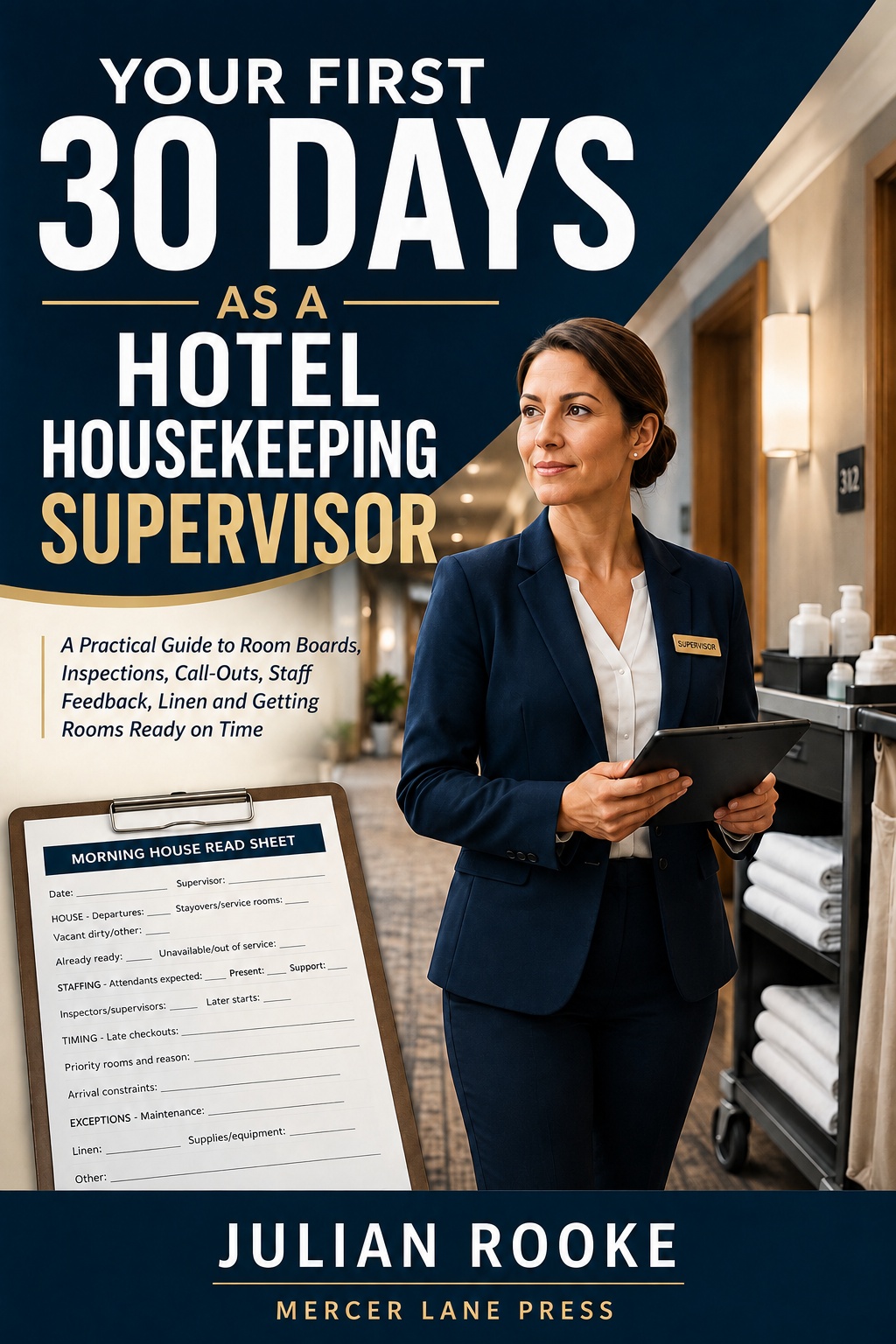
NEW HOTEL HOUSEKEEPING SUPERVISORS
A Practical Guide to Room Boards, Inspections, Call-Outs, Staff Feedback, Linen and Getting Rooms Ready on Time
By Julian Rooke · Published by Mercer Lane Press
A practical first-month field guide for newly promoted hotel housekeeping supervisors, covering the morning operating picture, fair room boards, call-outs, room-status control, inspections, front-desk coordination, linen and supply problems, staff feedback, training, handovers, and a structured 30-day development plan.
WHO IT IS FOR
New and newly promoted hotel housekeeping supervisors, especially experienced room attendants moving into responsibility for room boards, inspection flow, priorities, call-outs, linen and supply problems, front-desk coordination, staff coaching, blocked rooms, and end-of-shift handovers.
THE OPERATING SEQUENCE
The book uses one simple sequence to keep the supervisor focused on the whole shift rather than the next room directly in front of them.
Start with the actual room picture, current staffing, genuine priorities, late checkouts, known blocks, and supply or equipment risks.
Create workable room boards from the work and people actually available, not from yesterday's forecast or raw room counts alone.
Tell the team what is different today: workload, priorities, late checkouts, staffing changes, assignment changes, and exceptions.
When reality changes, recount capacity, identify the current bottleneck, rebalance where justified, communicate changes, and escalate gaps that still do not fit.
Inspect against the property's actual standard, distinguish isolated misses from patterns, and follow up repeated defects instead of quietly fixing them forever.
Leave unresolved rooms, maintenance, status questions, supply risks, and follow-up actions in a form the next person can continue without reconstructing the shift from memory.
ROOM BOARDS AND CAPACITY
The book separates visible room totals from the operational factors that make one assignment materially harder than another.
Departures, stayovers, suites, multiple-bed rooms, special setups, and other legitimate workload differences can make identical room counts misleading.
Geography, late checkouts, priority arrivals, floor changes, trolley access, and room release times can alter the practical weight of a board.
Training level can matter, and supervisors should notice when the same strong employee repeatedly becomes the automatic answer whenever the plan breaks.
An absence is not simply a missing board to divide among everyone else. The supervisor needs to recount what capacity disappeared before deciding what work can still be protected.
When reasonable rebalancing and authorised support still leave more work than the available team can absorb, the remaining capacity gap should be made visible and escalated.
The bottleneck can move from cleaning to inspection, maintenance, room release, information, linen, or another constraint during the same shift.
ROOM READINESS AND INSPECTION
A useful operating picture distinguishes rooms that have not started, are in progress, have been cleaned, are waiting for inspection, are blocked, or are genuinely ready.
A large inspection queue can make guests wait even when cleaning progress is reasonable. A group of blocked rooms may point to maintenance rather than housekeeping production.
The supervisor's job is not to invent parallel paperwork. It is to keep the hotel's actual source of truth accurate enough for other departments to make decisions.
For an important room, communicate the current stage, next action, and next useful update instead of promising a completion time that the evidence does not support.
Use the property's formal inspection standard and a repeatable route so employees are not guessing what will pass depending on which supervisor enters the room.
A repeat miss can be individual, training-related, supply-related, or systemic. Recording enough evidence helps separate memory from a real pattern.
Maintenance and other exceptions should have an owner, a next action, appropriate communication, and a recheck point so the room does not disappear from view.
SUPERVISING PEOPLE
The transition can be especially awkward when yesterday's coworkers now receive assignments, inspections, and feedback from you.
Where an explanation is useful, give the operational reason for a board or priority decision rather than relying on status or authority as the explanation.
Correct the work that can be described: the missing setup, the visible defect, the board position, or the missed update. Avoid turning a work problem into a personality label.
Show the approved process, watch the employee perform it, correct specific actions, repeat, and confirm. Taking over may finish today's room without improving tomorrow's performance.
THE FIRST 30 DAYS
The month is structured around observation first, then deliberate shift control, recurring-problem diagnosis, communication and coaching, and finally a repeatable supervisor routine.
Clarify decision authority, room-status language, information routes, safety and escalation routes, and where rooms, people, or information regularly wait.
Use the same morning read, fairness check, progress checkpoints, capacity response, front-desk updates, and end-of-shift review across several shifts.
Look for recurring bottlenecks, test one small improvement at a time, make repeated answers more visible, and follow up coaching instead of treating the conversation as the finish line.
Create deliberate control points through the day, recognise common escalation triggers, review the 30-day scorecard, and choose a small number of Month 2 capabilities to practise.
FIELD MANUAL
The final section condenses the operating ideas into quick-reference checks and working sheets.
Morning House Read, room-board check, call-out decision tree, room-flow check, and blocked-room record.
A compact place to track staffing, priorities, the largest queue, inspection concerns, blocked rooms, supply risks, board changes, updates owed, and coaching follow-up.
Repeatable inspection steps, quick feedback structures, a training loop, linen-shortage checks, and an exception sequence for issues that need the property's formal process.
A structured handover for unresolved priorities, unfinished rooms, blocked rooms, maintenance, supply or equipment risks, status questions, employee follow-up, and the first action for the next supervisor.
FREE SUPPORTING GUIDES
These guides pull six practical problems out of the wider operating system so readers can start with the issue happening on today's shift.
HOTEL HOUSEKEEPING
Move beyond equal room counts and build room boards that can be explained using the work that actually exists.
Read the guideHOTEL HOUSEKEEPING
Treat a call-out as a capacity change, not just a missing board that must be divided among the remaining attendants.
Read the guideHOTEL HOUSEKEEPING
A room can be cleaned and still not be usable. Break the queue into stages before deciding what is actually slowing readiness.
Read the guideHOTEL HOUSEKEEPING
Use current stage, next action, and the next useful update instead of unsupported promises about when a room will be ready.
Read the guideHOTEL HOUSEKEEPING
Correct the work without labelling the person, and handle former-peer boundaries with consistent operational reasons.
Read the guideHOTEL HOUSEKEEPING
Close the shift by leaving unresolved work with enough detail that the next supervisor can continue without reconstructing the day.
Read the guidePROPERTY-SPECIFIC PROCEDURES COME FIRST
The book is an independent practical guide. Hotels vary in staffing models, room types, productivity expectations, inspection standards, systems, cleaning products, security procedures, management structures, and employment requirements.
SEARCH BY THE PROBLEM
Searches around hotel housekeeping supervisor checklists, room inspection checklists, housekeeping supervisor duties and room-readiness control reflect the same first-line challenge: keeping rooms, people, inspections and exceptions moving together.