Role
Set the relevant working perspective, such as recruiter, HR business partner, HR coordinator, or people analytics specialist.
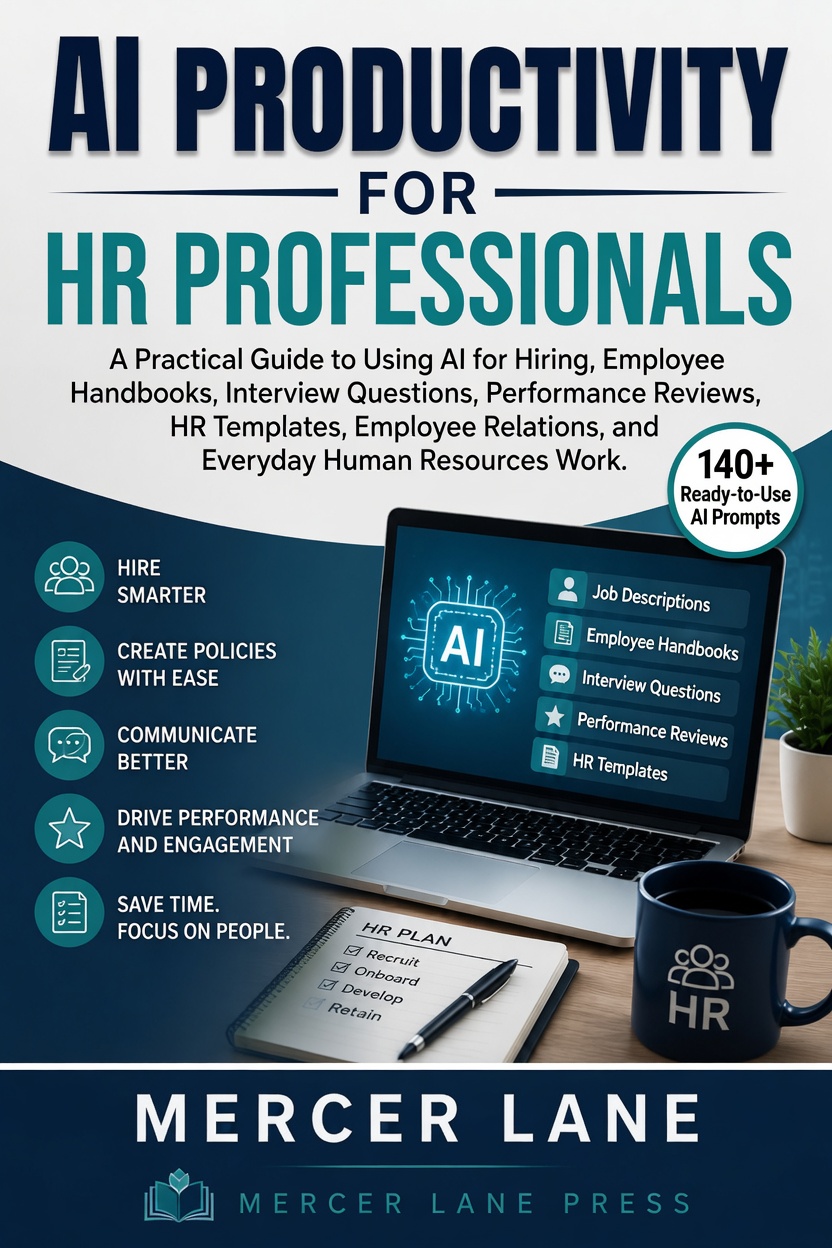
AI FOR HR PROFESSIONALS
A Practical Guide to Using AI for Hiring, Employee Handbooks, Interview Questions, Performance Reviews, HR Templates, Employee Relations, and Everyday Human Resources Work
By Mercer Lane · Published by Mercer Lane Press
A practical working reference for HR professionals using AI for recurring drafting, communication, documentation, reporting, onboarding, performance management, employee relations, learning and development, and other everyday HR work, with 141 ready-to-use prompts, five connected workflows, five action plans, and a Role + Task + Context + Output framework.
WHO IT IS FOR
HR generalists, recruiters, HR business partners, people operations staff, small HR teams, and other human-resources professionals who want repeatable AI-assisted drafting and workflow support while keeping human judgment, confidentiality, factual review, and appropriate legal or compliance review in the loop.
THE CORE PROMPT FORMULA
The book teaches one reusable structure for making AI instructions more specific: define the working role, state the exact task, provide the relevant context, and specify the output format. Every generated result remains a draft to review, edit, verify, and—where appropriate—send through legal or compliance review.
Set the relevant working perspective, such as recruiter, HR business partner, HR coordinator, or people analytics specialist.
Name the job clearly and provide only the facts the draft needs, while minimizing confidential or identifiable employee information.
Specify the usable format, then check facts, tone, policy alignment, privacy, and any legal or compliance implications before use.
WHAT IT COVERS
Job descriptions, job postings, sourcing strings, screening questions, behavioral interviews, scorecards, candidate communication, offers, panel briefing, comparisons, sourcing strategy, and reference checks.
30-60-90 plans, pre-boarding messages, manager preparation, buddy programs, early feedback, exit interviews, engagement surveys, recognition, return-to-work planning, and remote-hire setup.
Performance-review drafts, self-assessments, SMART goals, PIP structures, coaching talking points, 360 summaries, promotion cases, difficult feedback, role-play, recognition, and check-ins.
Policy announcements, workplace changes, deadline reminders, restructuring talking points, FAQs, team updates, sensitive messages, values communication, survey results, and tone improvement.
Policy and handbook drafts, SOPs, document summaries, incident records, investigation questions, change logs, accommodation-process drafts, and data-retention summaries—with human and legal review where appropriate.
Headcount, attrition, recruiting funnels, representation metrics, compensation benchmarking, absence patterns, dashboards, engagement data, training results, leadership summaries, span of control, and internal mobility.
Training outlines, manager micro-lessons, learning paths, skills gaps, mentorship, new-manager curricula, feedback surveys, internal mobility, learning summaries, training nudges, coaching skills, and program pitches.
Mediation preparation, complaint summaries, diagnostic questions, de-escalation language, trust rebuilding, bias checks, difficult-conversation role-play, grievance drafts, workshops, and manager talking points.
WORKFLOWS & ACTION PLANS
The book connects prompts into five workflows: requisition-to-offer hiring, new-hire onboarding, the performance-review cycle, employee query and case resolution, and compliance/documentation. Five mini action plans cover a 7-day AI adoption sprint, weekly recruitment, monthly reporting, difficult-conversation preparation, and quarterly compliance documentation.
FREE SUPPORTING GUIDES
HR AI
Define the role, task, relevant context, and required output before asking AI to draft HR material.
Read the guideHR AI
Give an AI tool only the information the drafting task genuinely needs, and keep identifiable or confidential employee data inside approved systems.
Read the guideHR AI
Organize evidence first, ask AI for a structured draft, then verify examples, tone, goals, and company requirements before anything enters the formal review.
Read the guideHR AI
AI can help structure talking points, neutral questions, mediation preparation, and role-play, but it should support—not replace—the HR professional in sensitive employee-relations work.
Read the guideHR AI
Connect reviewed prompts into small, repeatable sequences instead of rebuilding the same HR drafting tasks from scratch.
Read the guidePut Role + Task + Context + Output to work on one employee review. Download an Excel review workbook, editable Word form and printable PDFs, or build a review prompt locally in your browser.
SEARCH BY THE PROBLEM
Searches for AI prompts for HR, ChatGPT prompts for HR, performance-review drafting, interview questions and onboarding support all point to the same need: usable first drafts with enough context, privacy discipline and human review to fit real HR work.